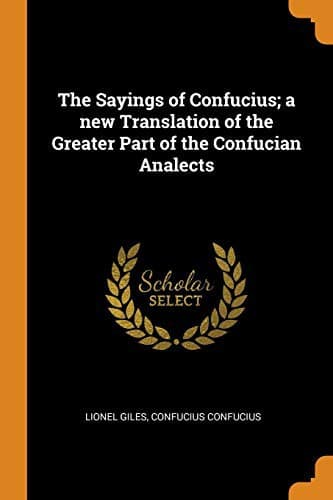
The Sayings of Confucius: A New Translation of the Greater Part of the Confucian Analects — John Shaqi
The Sayings of Confucius: A New Translation of the Greater Part of the Confucian AnalectsConfucius
ReligionEastern
The Sayings of Confucius: A New Translation of the Greater Part of the Confucian Analects
Confucius
Ethics -- China; Philosophy, Chinese
Of the life of Confucius only the barest sketch can be given here,
but stress may be laid on one or two points which it is important to
bear in mind. Confucius was born at a time when the feudal system,
established several centuries earlier by the founder of the Chou
dynasty, was showing unmistakable signs of disruption and decay. It
is almost certain that China had been feudally governed from the very
earliest times, but Wu Wang placed the whole system on a seemingly
firmer basis than ever. He divided his realm into a large number of
vassal states, which he bestowed upon his own kith and kin who had
helped him to the throne. Thus the Empire really came to resemble the
huge united family which Chinese political theorists declare it to be,
and for a short time all seems to have worked smoothly. But as the
bonds of kinship grew looser, the central government gradually lost
all effective control over its unruly children, and the various states
were soon embroiled in perpetual feuds and struggles among themselves,
besides being usually at loggerheads with the parent dynasty. The state
of things that ensued may be likened (though on a far larger scale) to
several Wars of the Roses going on at the same time, or better still,
to the turbulence of the later days of the Holy Roman Empire, when the
fealty of its members had become merely nominal. Matters were further
complicated in many of the states by the upgrowth of large and powerful
families which often attempted either by insidious methods or by open
violence to wrest the supreme authority into their own hands. Thus in
Lu, the comparatively small state to which Confucius belonged, there
were three such families, the Chi, the Mêng, and the Shu; the heads of
these clans, of whom we hear a good deal in the Analects, had already,
by the time of Confucius, reduced their lawful prince (or duke, as
he is generally called) to a condition of virtual dependency. On the
other hand, they themselves were sometimes threatened by the lawless
behaviour of their own officers, such as the ambitious chariot-driver,
Yang Huo,[1] who thought nothing of seizing towns or even the person
of his own chief, in order to hold him to ransom. Thus, though the
period of the "Warring States" is not usually reckoned as beginning
until after the death of Confucius, the date is a purely arbitrary one,
inasmuch as his whole life long disturbances were rife and military
operations well-nigh incessant throughout the length and breadth of
China. In the midst of the prevailing disorder, Confucius comported
himself with an admirable mixture of dignity, tact and outspoken
courage. Wisely opposing the dangerous tendency to decentralisation,
and upholding the supreme authority of the Emperor as against his too
powerful vassals, he heartily disapproved of the illegal usurpations
of the dukes, the great families and the soldiers of fortune that
preyed one upon the other, and did not shrink on occasion from
Public-domain text, read in full here on John Shaqi.
Reviews
Reviews
No reviews yet
Be the first to share your thoughts on this work.
Join the Discussion
Join the discussion
Sign in to leave a comment or review.
Sign InorCreate an account