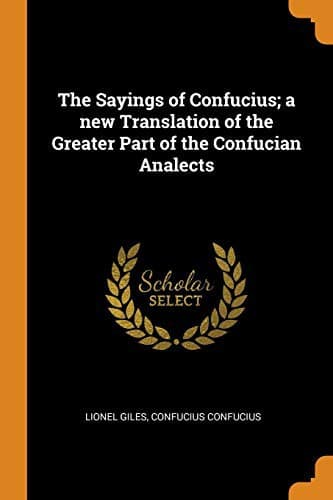
The Sayings of Confucius: A New Translation of the Greater Part of the Confucian AnalectsConfucius
ReligionEastern
The Sayings of Confucius: A New Translation of the Greater Part of the Confucian Analects
Confucius
Ethics -- China; Philosophy, Chinese
expressing his disgust in unequivocal terms. But knowing the futility
of protests unbacked by force, he kept himself aloof for the most
part, and devoted himself to a long course of study and teaching,
gathering, it is said, as many as three thousand disciples around him.
This is a palpable exaggeration, but there can be no doubt that he had
become a marked man and gained great fame as a moralist and teacher
many years before he actually took office. In 501 B.C., at the age of
fifty, he at last made his entry on the political stage by accepting
the governorship of a small town in Lu. Here he is said to have been
eminently successful in the work of reform, and he rapidly rose to be
the most trusted adviser of Duke Ting, who on one occasion at least
owed his life to the courage and address of his minister. But it was
not long ere the weak and fickle character of the ruler, carefully
manipulated by rivals to Confucius, brought about a catastrophe. The
neighbouring state of Ch‘i, jealous of the new prosperity of Lu under
the régime of the sage, cunningly sent as a gift to the prince a
band of beautiful women, trained in song and dance, and a number of
magnificent horses, in order to distract his mind from the serious
cares of state. The plotters had evidently taken the measure of their
victim, for the artifice succeeded, and Confucius felt compelled to
resign. Then began the weary years of wandering from state to state, in
which we cannot follow him here, except to note a sagacious prophecy
uttered by a friendly official on the frontier of Wei. Coming out from
an interview with Confucius, he comforted the woebegone disciples by
telling them that their Master's divine mission was now only just
beginning.[2] It may, indeed, be that the ensuing period of homeless
exile, hardships and danger, did more to spread the fame of the great
reformer than either the few brilliant years of office or those spent
as a teacher in the comparative seclusion of Lu. For one thing, it
could not but inspire and fortify his followers to observe that the
lofty principles which a sudden accession to power had failed to
corrupt, were equally capable of standing the test of adversity. His
serene and courageous bearing in many a strange and perilous situation
proved that the conception of a "higher type of man" was for him no
empty ideal, but the worthy object of practical endeavour. It is sad,
however, to reflect that the best years of his life had passed before
the call came which resulted in his return. Had it not been so long
delayed, he would doubtless have thrown himself once more into the
arena of public affairs, and begun rebuilding the fabric of good
government which had been so rudely shattered thirteen years before.
His patience would have been equal to the task; but he was now an old
man, worn out by years of travel, privation and anxiety, at a time of
life when the physical frame begins to demand a certain measure of
quiet and repose.
Public-domain text, read in full here on John Shaqi.
Reviews
Reviews
No reviews yet
Be the first to share your thoughts on this work.
Join the Discussion
Join the discussion
Sign in to leave a comment or review.
Sign InorCreate an account