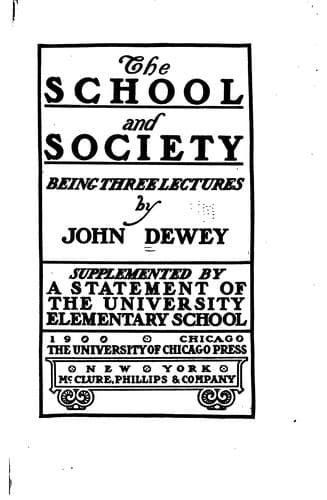
The School and Society: Being three lecturesDewey, John
Philosophy
The School and Society: Being three lectures
Dewey, John
Education; Education -- Philosophy; Educational psychology; University of Chicago. University Elementary School
They then followed the processes necessary for working the fibers up
into cloth. They re-invented the first frame for carding the wool—a
couple of boards with sharp pins in them for scratching it out. They
re-devised the simplest process for spinning the wool—a pierced stone or
some other weight through which the wool is passed, and which as it is
twirled draws out the fiber; next the top, which was spun on the floor,
while the children kept the wool in their hands until it was gradually
drawn out and wound upon it. Then the children are introduced to the
invention next in historic order, working it out experimentally, thus
seeing its necessity, and tracing its effects, not only upon that
particular industry, but upon modes of social life—in this way passing
in review the entire process up to the present complete loom, and all
that goes with the application of science in the use of our present
available powers. I need not speak of the science involved in this—the
study of the fibers, of geographical features, the conditions under
which raw materials are grown, the great centers of manufacture and
distribution, the physics involved in the machinery of production; nor,
again, of the historical side—the influence which these inventions have
had upon humanity. You can concentrate the history of all mankind into
the evolution of the flax, cotton, and wool fibers into clothing. I do
not mean that this is the only, or the best, center. But it is true that
certain very real and important avenues to the consideration of the
history of the race are thus opened—that the mind is introduced to much
more fundamental and controlling influences than usually appear in the
political and chronological records that pass for history.
Now, what is true of this one instance of fibers used in fabrics (and,
of course, I have only spoken of one or two elementary phases of that)
is true in its measure of every material used in every occupation, and
of the processes employed. The occupation supplies the child with a
genuine motive; it gives him experience at first hand; it brings him
into contact with realities. It does all this, but in addition it is
liberalized throughout by translation into its historic values and
scientific equivalencies. With the growth of the child’s mind in power
and knowledge it ceases to be a pleasant occupation merely, and becomes
more and more a medium, an instrument, an organ—and is thereby
transformed.
Public-domain text, read in full here on John Shaqi.
Reviews
Reviews
No reviews yet
Be the first to share your thoughts on this work.
Join the Discussion
Join the discussion
Sign in to leave a comment or review.
Sign InorCreate an account