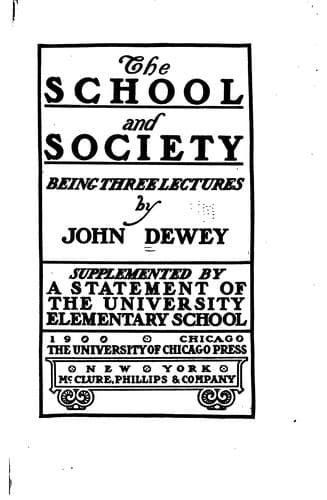
The School and Society: Being three lectures — John Shaqi
The School and Society: Being three lecturesDewey, John
Philosophy
The School and Society: Being three lectures
Dewey, John
Education; Education -- Philosophy; Educational psychology; University of Chicago. University Elementary School
This, in turn, has its bearing upon the teaching of science. Under
present conditions, all activity, to be successful, has to be directed
somewhere and somehow by the scientific expert—it is a case of applied
science. This connection should determine its place in education. It is
not only that the occupations, the so-called manual or industrial work
in the school, give the opportunity for the introduction of science
which illuminates them, which makes them material, freighted with
meaning, instead of being mere devices of hand and eye; but that the
scientific insight thus gained becomes an indispensable instrument of
free and active participation in modern social life. Plato somewhere
speaks of the slave as one who in his actions does not express his own
ideas, but those of some other man. It is our social problem now, even
more urgent than in the time of Plato, that method, purpose,
understanding, shall exist in the consciousness of the one who does the
work, that his activity shall have meaning to himself.
When occupations in the school are conceived in this broad and generous
way, I can only stand lost in wonder at the objections so often heard,
that such occupations are out of place in the school because they are
materialistic, utilitarian, or even menial in their tendency. It
sometimes seems to me that those who make these objections must live in
quite another world. The world in which most of us live is a world in
which everyone has a calling and occupation, something to do. Some are
managers and others are subordinates. But the great thing for one as for
the other is that each shall have had the education which enables him to
see within his daily work all there is in it of large and human
significance. How many of the employed are today mere appendages to the
machines which they operate! This may be due in part to the machine
itself, or to the _régime_ which lays so much stress upon the products
of the machine; but it is certainly due in large part to the fact that
the worker has had no opportunity to develop his imagination and his
sympathetic insight as to the social and scientific values found in his
work. At present, the impulses which lie at the basis of the industrial
system are either practically neglected or positively distorted during
the school period. Until the instincts of construction and production
are systematically laid hold of in the years of childhood and youth,
until they are trained in social directions, enriched by historical
interpretation, controlled and illuminated by scientific methods, we
certainly are in no position even to locate the source of our economic
evils, much less to deal with them effectively.
Public-domain text, read in full here on John Shaqi.
Reviews
Reviews
No reviews yet
Be the first to share your thoughts on this work.
Join the Discussion
Join the discussion
Sign in to leave a comment or review.
Sign InorCreate an account