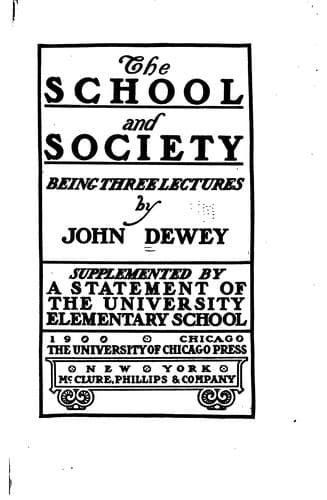
The School and Society: Being three lectures — John Shaqi
The School and Society: Being three lecturesDewey, John
Philosophy
The School and Society: Being three lectures
Dewey, John
Education; Education -- Philosophy; Educational psychology; University of Chicago. University Elementary School
If we take an example from an ideal home, where the parent is
intelligent enough to recognize what is best for the child, and is able
to supply what is needed, we find the child learning through the social
converse and constitution of the family. There are certain points of
interest and value to him in the conversation carried on: statements are
made, inquiries arise, topics are discussed, and the child continually
learns. He states his experiences, his misconceptions are corrected.
Again the child participates in the household occupations, and thereby
gets habits of industry, order, and regard for the rights and ideas of
others, and the fundamental habit of subordinating his activities to the
general interest of the household. Participation in these household
tasks becomes an opportunity for gaining knowledge. The ideal home would
naturally have a workshop where the child could work out his
constructive instincts. It would have a miniature laboratory in which
his inquiries could be directed. The life of the child would extend out
of doors to the garden, surrounding fields, and forests. He would have
his excursions, his walks and talks, in which the larger world out of
doors would open to him.
Now, if we organize and generalize all of this, we have the ideal
school. There is no mystery about it, no wonderful discovery of pedagogy
or educational theory. It is simply a question of doing systematically
and in a large, intelligent, and competent way what for various reasons
can be done in most households only in a comparatively meager and
haphazard manner. In the first place, the ideal home has to be enlarged.
The child must be brought into contact with more grown people and with
more children in order that there may be the freest and richest social
life. Moreover, the occupations and relationships of the home
environment are not specially selected for the growth of the child; the
main object is something else, and what the child can get out of them is
incidental. Hence the need of a school. In this school the life of the
child becomes the all-controlling aim. All the media necessary to
further the growth of the child center there. Learning?—certainly, but
living primarily, and learning through and in relation to this living.
When we take the life of the child centered and organized in this way,
we do not find that he is first of all a listening being; quite the
contrary.
Public-domain text, read in full here on John Shaqi.
Reviews
Reviews
No reviews yet
Be the first to share your thoughts on this work.
Join the Discussion
Join the discussion
Sign in to leave a comment or review.
Sign InorCreate an account