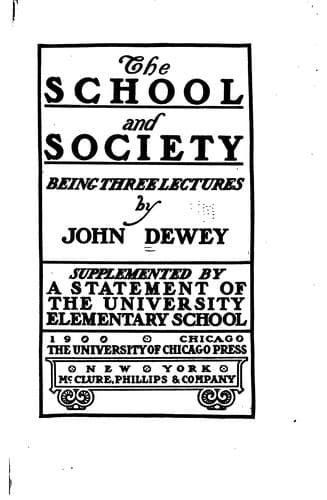
The School and Society: Being three lecturesDewey, John
Philosophy
The School and Society: Being three lectures
Dewey, John
Education; Education -- Philosophy; Educational psychology; University of Chicago. University Elementary School
The statement so frequently made that education means “drawing out” is
excellent, if we mean simply to contrast it with the process of pouring
in. But, after all, it is difficult to connect the idea of drawing out
with the ordinary doings of the child of three, four, seven, or eight
years of age. He is already running over, spilling over, with activities
of all kinds. He is not a purely latent being whom the adult has to
approach with great caution and skill in order gradually to draw out
some hidden germ of activity. The child is already intensely active, and
the question of education is the question of taking hold of his
activities, of giving them direction. Through direction, through
organized use, they tend toward valuable results, instead of scattering
or being left to merely impulsive expression.
If we keep this before us, the difficulty I find uppermost in the minds
of many people regarding what is termed the new education is not so much
solved as dissolved; it disappears. A question often asked is: if you
begin with the child’s ideas, impulses and interests, all so crude, so
random and scattering, so little refined or spiritualized, how is he
going to get the necessary discipline, culture and information? If there
were no way open to us except to excite and indulge these impulses of
the child, the question might well be asked. We should either have to
ignore and repress the activities, or else to humor them. But if we have
organization of equipment and of materials, there is another path open
to us. We can direct the child’s activities, giving them exercise along
certain lines, and can thus lead up to the goal which logically stands
at the end of the paths followed.
“If wishes were horses, beggars would ride.” Since they are not, since
really to satisfy an impulse or interest means to work it out, and
working it out involves running up against obstacles, becoming
acquainted with materials, exercising ingenuity, patience, persistence,
alertness, it of necessity involves discipline—ordering of power—and
supplies knowledge. Take the example of the little child who wants to
make a box. If he stops short with the imagination or wish, he certainly
will not get discipline. But when he attempts to realize his impulse, it
is a question of making his idea definite, making it into a plan, of
taking the right kind of wood, measuring the parts needed, giving them
the necessary proportions, etc. There is involved the preparation of
materials, the sawing, planing, the sand-papering, making all the edges
and corners to fit. Knowledge of tools and processes is inevitable. If
the child realizes his instinct and makes the box, there is plenty of
opportunity to gain discipline and perseverance, to exercise effort in
overcoming obstacles, and to attain as well a great deal of information.
Public-domain text, read in full here on John Shaqi.
Reviews
Reviews
No reviews yet
Be the first to share your thoughts on this work.
Join the Discussion
Join the discussion
Sign in to leave a comment or review.
Sign InorCreate an account