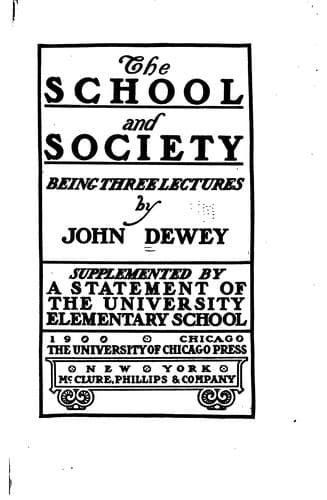
The School and Society: Being three lecturesDewey, John
Philosophy
The School and Society: Being three lectures
Dewey, John
Education; Education -- Philosophy; Educational psychology; University of Chicago. University Elementary School
So undoubtedly the little child who thinks he would like to cook has
little idea of what it means or costs, or what it requires. It is simply
a desire to “mess around,” perhaps to imitate the activities of older
people. And it is doubtless possible to let ourselves down to that level
and simply humor that interest. But here, too, if the impulse is
exercised, utilized, it runs up against the actual world of hard
conditions, to which it must accommodate itself; and there again come in
the factors of discipline and knowledge. One of the children became
impatient recently, at having to work things out by a long method of
experimentation, and said: “Why do we bother with this? Let’s follow a
recipe in a cook-book.” The teacher asked the children where the recipe
came from, and the conversation showed that if they simply followed this
they would not understand the reasons for what they were doing. They
were then quite willing to go on with the experimental work. To follow
that work will, indeed, give an illustration of just the point in
question. Their occupation happened that day to be the cooking of eggs,
as making a transition from the cooking of vegetables to that of meats.
In order to get a basis of comparison they first summarized the
constituent food elements in the vegetables and made a preliminary
comparison with those found in meat. Thus they found that the woody
fiber or cellulose in vegetables corresponded to the connective tissue
in meat, giving the element of form and structure. They found that
starch and starchy products were characteristic of the vegetables, that
mineral salts were found in both alike, and that there was fat in both—a
small quantity in vegetable food and a large amount in animal. They were
prepared then to take up the study of albumen as the characteristic
feature of animal food, corresponding to starch in the vegetables, and
were ready to consider the conditions requisite for the proper treatment
of albumen—the eggs serving as the material of experiment.
[Illustration: CHILD’S DRAWING OF A CAVE AND TREES]
They experimented first by taking water at various temperatures, finding
out when it was scalding, simmering, and boiling hot, and ascertained
the effect of the various degrees of temperature on the white of the
egg. That worked out, they were prepared, not simply to cook eggs, but
to understand the principle involved in the cooking of eggs. I do not
wish to lose sight of the universal in the particular incident. For the
child simply to desire to cook an egg, and accordingly drop it in water
for three minutes, and take it out when he is told, is not educative.
But for the child to realize his own impulse by recognizing the facts,
materials and conditions involved, and then to regulate his impulse
through that recognition, is educative. This is the difference, upon
which I wish to insist, between exciting or indulging an interest and
realizing it through its direction.
Public-domain text, read in full here on John Shaqi.
Reviews
Reviews
No reviews yet
Be the first to share your thoughts on this work.
Join the Discussion
Join the discussion
Sign in to leave a comment or review.
Sign InorCreate an account