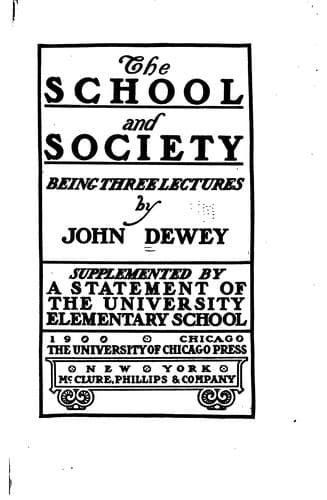
The School and Society: Being three lecturesDewey, John
Philosophy
The School and Society: Being three lectures
Dewey, John
Education; Education -- Philosophy; Educational psychology; University of Chicago. University Elementary School
Though there should be organic connection between the school and
business life, it is not meant that the school is to prepare the child
for any particular business, but that there should be a natural
connection of the everyday life of the child with the business
environment about him, and that it is the affair of the school to
clarify and liberalize this connection, to bring it to consciousness,
not by introducing special studies, like commercial geography and
arithmetic, but by keeping alive the ordinary bonds of relation. The
subject of compound-business-partnership is probably not in many of the
arithmetics nowadays, though it was there not a generation ago, for the
makers of text-books said that if they left out anything they could not
sell their books. This compound-business-partnership originated as far
back as the sixteenth century. The joint-stock company had not been
invented, and as large commerce with the Indies and Americas grew up, it
was necessary to have an accumulation of capital with which to handle
it. One man said, “I will put in this amount of money for six months,”
and another, “So much for two years,” and so on. Thus by joining
together they got money enough to float their commercial enterprises.
Naturally, then, “compound partnership” was taught in the schools. The
joint-stock company was invented; compound partnership disappeared, but
the problems relating to it stayed in the arithmetics for two hundred
years. They were kept after they had ceased to have practical utility,
for the sake of mental discipline—they were “such hard problems, you
know.” A great deal of what is now in the arithmetics under the head of
percentage is of the same nature. Children of twelve and thirteen years
of age go through gain and loss calculations, and various forms of bank
discount so complicated that the bankers long ago dispensed with them.
And when it is pointed out that business is not done this way, we hear
again of “mental discipline.” And yet there are plenty of real
connections between the experience of children and business conditions
which need to be utilized and illuminated. The child should study his
commercial arithmetic and geography, not as isolated things by
themselves, but in their reference to his social environment. The youth
needs to become acquainted with the bank as a factor in modern life,
with what it does, and how it does it; and then relevant arithmetical
processes would have some meaning—quite in contradistinction to the
time-absorbing and mind-killing examples in percentage, partial
payments, etc., found in all our arithmetics.
Public-domain text, read in full here on John Shaqi.
Reviews
Reviews
No reviews yet
Be the first to share your thoughts on this work.
Join the Discussion
Join the discussion
Sign in to leave a comment or review.
Sign InorCreate an account