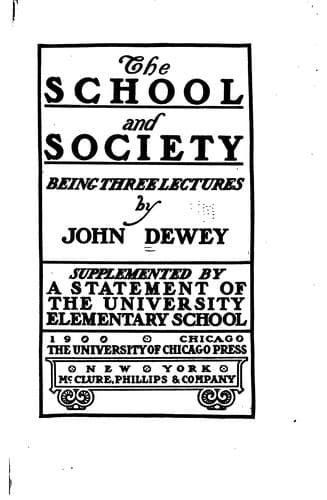
The School and Society: Being three lecturesDewey, John
Philosophy
The School and Society: Being three lectures
Dewey, John
Education; Education -- Philosophy; Educational psychology; University of Chicago. University Elementary School
That the dining-room and kitchen connect with the country and its
processes and products it is hardly necessary to say. Cooking may be so
taught that it has no connection with country life, and with the
sciences that find their unity in geography. Perhaps it generally has
been taught without these connections being really made. But all the
materials that come into the kitchen have their origin in the country;
they come from the soil, are nurtured through the influences of light
and water, and represent a great variety of local environments. Through
this connection, extending from the garden into the larger world, the
child has his most natural introduction to the study of the sciences.
Where did these things grow? What was necessary to their growth? What
their relation to the soil? What the effect of different climatic
conditions? and so on. We all know what the old-fashioned botany was:
partly collecting flowers that were pretty, pressing and mounting them;
partly pulling these flowers to pieces and giving technical names to the
different parts, finding all the different leaves, naming all their
different shapes and forms. It was a study of plants without any
reference to the soil, to the country, or to growth. In contrast, a real
study of plants takes them in their natural environment and in their
uses as well, not simply as food, but in all their adaptations to the
social life of man. Cooking becomes as well a most natural introduction
to the study of chemistry, giving the child here also something which he
can at once bring to bear upon his daily experience. I once heard a very
intelligent woman say that she could not understand how science could be
taught to little children, because she did not see how they could
understand atoms and molecules. In other words, since she did not see
how highly abstract facts could be presented to the child independently
of daily experience, she could not understand how science could be
taught at all. Before we smile at this remark, we need to ask ourselves
if she is alone in her assumption, or whether it simply formulates
almost all of our school practice.
The same relations with the outside world are found in the carpentry and
the textile shops. They connect with the country, as the source of their
materials, with physics, as the science of applying energy, with
commerce and distribution, with art in the development of architecture
and decoration. They have also an intimate connection with the
university on the side of its technological and engineering schools;
with the laboratory, and its scientific methods and results.
Public-domain text, read in full here on John Shaqi.
Reviews
Reviews
No reviews yet
Be the first to share your thoughts on this work.
Join the Discussion
Join the discussion
Sign in to leave a comment or review.
Sign InorCreate an account