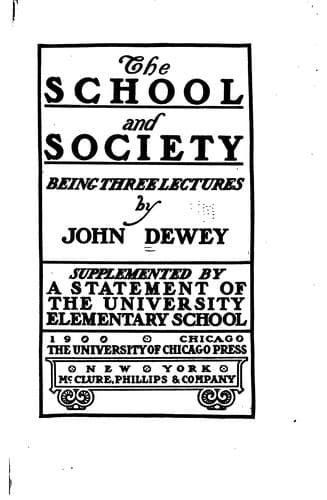
The School and Society: Being three lecturesDewey, John
Philosophy
The School and Society: Being three lectures
Dewey, John
Education; Education -- Philosophy; Educational psychology; University of Chicago. University Elementary School
Speaking more especially with reference to the pedagogical side of the
work: I suppose the oldest university chair of pedagogy in our country
is about twenty years old—that of the University of Michigan, founded in
the latter seventies. But there are only one or two that have tried to
make a connection between theory and practice. They teach for the most
part by theory, by lectures, by reference to books, rather than through
the actual work of teaching itself. At Columbia, through the Teachers’
College, there is an extensive and close connection between the
University and the training of teachers. Something has been done in one
or two other places along the same line. We want an even more intimate
union here, so that the University shall put all its resources at the
disposition of the elementary school, contributing to the evolution of
valuable subject-matter and right method, while the school in turn will
be a laboratory in which the student of education sees theories and
ideas demonstrated, tested, criticised, enforced, and the evolution of
new truths. We want the school in its relation to the University to be a
working model of a unified education.
A word as to the relation of the school to educational interests
generally. I heard once that the adoption of a certain method in use in
our school was objected to by a teacher on this ground: “You know that
it is an experimental school. They do not work under the same conditions
that we are subject to.” Now, the purpose of performing an experiment is
that other people need not experiment; at least need not experiment so
much, may have something definite and positive to go by. An experiment
demands particularly favorable conditions in order that results may be
reached both freely and securely. It has to work unhampered, with all
the needed resources at command. Laboratories lie back of all the great
business enterprises of today, back of every great factory, every
railway and steamship system. Yet the laboratory is not a business
enterprise; it does not aim to secure for itself the conditions of
business life, nor does the commercial undertaking repeat the
laboratory. There is a difference between working out and testing a new
truth, or a new method, and applying it on a wide scale, making it
available for the mass of men, making it commercial. But the first thing
is to discover the truth, to afford all necessary facilities, for this
is the most practical thing in the world in the long run. We do not
expect to have other schools literally imitate what we do. A working
model is not something to be copied; it is to afford a demonstration of
the feasibility of the principle, and of the methods which make it
feasible. So (to come back to our own point) we want here to work out
the problem of the unity, the organization of the school system in
itself, and to do this by relating it so intimately to life as to
demonstrate the possibility and necessity of such organization for all
education.
Public-domain text, read in full here on John Shaqi.
Reviews
Reviews
No reviews yet
Be the first to share your thoughts on this work.
Join the Discussion
Join the discussion
Sign in to leave a comment or review.
Sign InorCreate an account