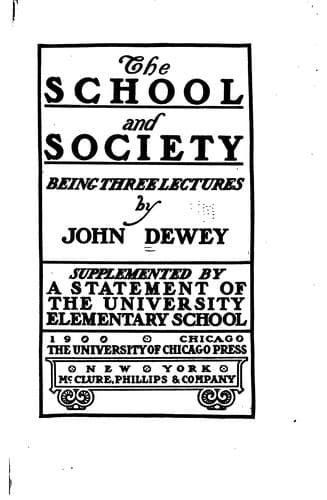
The School and Society: Being three lecturesDewey, John
Philosophy
The School and Society: Being three lectures
Dewey, John
Education; Education -- Philosophy; Educational psychology; University of Chicago. University Elementary School
Thus I have attempted to indicate how the school may be connected with
life so that the experience gained by the child in a familiar,
commonplace way is carried over and made use of there, and what the
child learns in the school is carried back and applied in everyday life,
making the school an organic whole, instead of a composite of isolated
parts. The isolation of studies as well as of parts of the school system
disappears. Experience has its geographical aspect, its artistic and its
literary, its scientific and its historical sides. All studies arise
from aspects of the one earth and the one life lived upon it. We do not
have a series of stratified earths, one of which is mathematical,
another physical, another historical, and so on. We should not live very
long in any one taken by itself. We live in a world where all sides are
bound together. All studies grow out of relations in the one great
common world. When the child lives in varied but concrete and active
relationship to this common world, his studies are naturally unified. It
will no longer be a problem to correlate studies. The teacher will not
have to resort to all sorts of devices to weave a little arithmetic into
the history lesson, and the like. Relate the school to life, and all
studies are of necessity correlated.
Moreover, if the school is related as a whole to life as a whole, its
various aims and ideals—culture, discipline, information, utility—cease
to be variants, for one of which we must select one study and for
another another. The growth of the child in the direction of social
capacity and service, his larger and more vital union with life, becomes
the unifying aim; and discipline, culture and information fall into
place as phases of this growth.
I wish to say one word more about the relationship of our particular
school to the University. The problem is to unify, to organize
education, to bring all its various factors together, through putting it
as a whole into organic union with everyday life. That which lies back
of the pedagogical school of the University is the necessity of working
out something to serve as a model for such unification, extending from
work beginning with the four-year-old child up through the graduate work
of the University. Already we have much help from the University in
scientific work planned, sometimes even in detail, by heads of the
departments. The graduate student comes to us with his researches and
methods, suggesting ideas and problems. The library and museum are at
hand. We want to bring all things educational together; to break down
the barriers that divide the education of the little child from the
instruction of the maturing youth; to identify the lower and the higher
education, so that it shall be demonstrated to the eye that there is no
lower and higher, but simply education.
Public-domain text, read in full here on John Shaqi.
Reviews
Reviews
No reviews yet
Be the first to share your thoughts on this work.
Join the Discussion
Join the discussion
Sign in to leave a comment or review.
Sign InorCreate an account