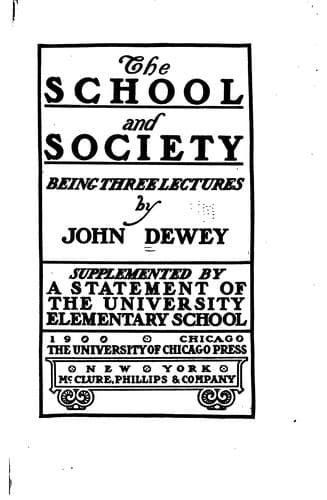
The School and Society: Being three lecturesDewey, John
Philosophy
The School and Society: Being three lectures
Dewey, John
Education; Education -- Philosophy; Educational psychology; University of Chicago. University Elementary School
organization and maintenance of foundation work in education as well as
for the later stages.
The elementary school has had from the outset two sides: one, the
obvious one of instruction of the children who have been intrusted to
it; the other, relationship to the University, since the school is under
the charge, and forms a part of the pedagogical work of the University.
When the school was started, there were certain ideas in mind—perhaps it
would be better to say questions and problems; certain points which it
seemed worth while to test. If you will permit one personal word, I
should like to say that it is sometimes thought that the school started
out with a number of ready-made principles and ideas which were to be
put into practice at once. It has been popularly assumed that I am the
author of these ready-made ideas and principles which were to go into
execution. I take this opportunity to say that the educational conduct
of the school, as well as its administration, the selection of
subject-matter, and the working out of the course of study, as well as
actual instruction of children, have been almost entirely in the hands
of the teachers of the school; and that there has been a gradual
development of the educational principles and methods involved, not a
fixed equipment. The teachers started with question marks, rather than
with fixed rules, and if any answers have been reached, it is the
teachers in the school who have supplied them. We started upon the whole
with four such questions, or problems:
1. What can be done, and how can it be done, to bring the school into
closer relation with the home and neighborhood life—instead of having
the school a place where the child comes solely to learn certain
lessons? What can be done to break down the barriers which have
unfortunately come to separate the school life from the rest of the
everyday life of the child? This does not mean, as it is sometimes,
perhaps, interpreted to mean, that the child should simply take up in
the school things already experienced at home and study them, but that,
so far as possible, the child shall have the same attitude and point of
view in the school as in the home; that he shall find the same interest
in going to school, and in there doing things worth doing for their own
sake, that he finds in the plays and occupations which busy him in his
home and neighborhood life. It means, again, that the motives which keep
the child at work and growing at home shall be used in the school, so
that he shall not have to acquire another set of principles of actions
belonging only to the school—separate from those of the home. It is a
question of the unity of the child’s experience, of its actuating
motives and aims, not of amusing or even interesting the child.
Public-domain text, read in full here on John Shaqi.
Reviews
Reviews
No reviews yet
Be the first to share your thoughts on this work.
Join the Discussion
Join the discussion
Sign in to leave a comment or review.
Sign InorCreate an account