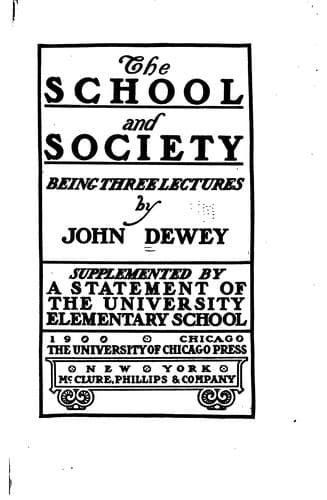
The School and Society: Being three lecturesDewey, John
Philosophy
The School and Society: Being three lectures
Dewey, John
Education; Education -- Philosophy; Educational psychology; University of Chicago. University Elementary School
2. What can be done in the way of introducing subject-matter in history
and science and art, that shall have a positive value and real
significance in the child’s own life; that shall represent, even to the
youngest children, something worthy of attainment in skill or knowledge;
as much so to the little pupil as are the studies of the high-school or
college student to him? You know what the traditional curriculum of the
first few years is, even though many modifications have been made. Some
statistics have been collected showing that 75 or 80 per cent. of the
first three years of a child in school are spent upon the form—not the
substance—of learning, the mastering of the symbols of reading, writing,
and arithmetic. There is not much positive nutriment in this. Its
purpose is important—is necessary—but it does not represent the same
kind of increase in a child’s intellectual and moral experience that is
represented by positive truth of history and nature, or by added insight
into reality and beauty. One thing, then, we wanted to find out is how
much can be given a child that is really worth his while to get, in
knowledge of the world about him, of the forces in the world, of
historical and social growth, and in capacity to express himself in a
variety of artistic forms. From the strictly educational side this has
been the chief problem of the school. It is along this line that we hope
to make our chief contribution to education in general; we hope, that
is, to work out and publish a positive body of subject-matter which may
be generally available.
3. How can instruction in these formal, symbolic branches—the mastering
of the ability to read, write, and use figures intelligently—be carried
on with everyday experience and occupation as their background and in
definite relations to other studies of more inherent content, and be
carried on in such a way that the child shall feel their necessity
through their connection with subjects which appeal to him on their own
account? If this can be accomplished, he will have a vital motive for
getting the technical capacity. It is not meant, as has been sometimes
jocosely stated, that the child learn to bake and sew at school, and to
read, write, and figure at home. It is intended that these formal
subjects shall not be presented in such large doses at first as to be
the exclusive objects of attention, and that the child shall be led by
that which he is doing to feel the need for acquiring skill in the use
of symbols and the immediate power they give. In any school, if the
child realizes the motive for the use and application of number and
language he has taken the longest step toward securing the power; and he
can realize the motive only as he has some particular—not some general
and remote—use for the symbols.
Public-domain text, read in full here on John Shaqi.
Reviews
Reviews
No reviews yet
Be the first to share your thoughts on this work.
Join the Discussion
Join the discussion
Sign in to leave a comment or review.
Sign InorCreate an account