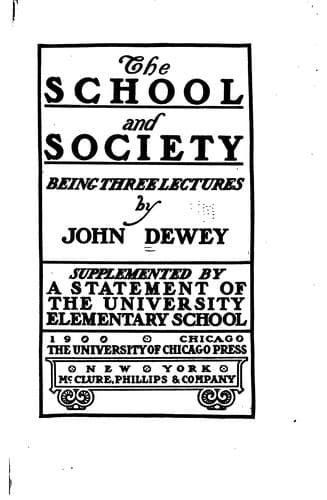
The School and Society: Being three lecturesDewey, John
Philosophy
The School and Society: Being three lectures
Dewey, John
Education; Education -- Philosophy; Educational psychology; University of Chicago. University Elementary School
Back of the factory system lies the household and neighborhood system.
Those of us who are here today need go back only one, two, or at most
three generations, to find a time when the household was practically the
center in which were carried on, or about which were clustered, all the
typical forms of industrial occupation. The clothing worn was for the
most part not only made in the house, but the members of the household
were usually familiar with the shearing of the sheep, the carding and
spinning of the wool, and the plying of the loom. Instead of pressing a
button and flooding the house with electric light, the whole process of
getting illumination was followed in its toilsome length, from the
killing of the animal and the trying of fat, to the making of wicks and
dipping of candles. The supply of flour, of lumber, of foods, of
building materials, of household furniture, even of metal ware, of
nails, hinges, hammers, etc., was in the immediate neighborhood, in
shops which were constantly open to inspection and often centers of
neighborhood congregation. The entire industrial process stood revealed,
from the production on the farm of the raw materials, till the finished
article was actually put to use. Not only this, but practically every
member of the household had his own share in the work. The children, as
they gained in strength and capacity, were gradually initiated into the
mysteries of the several processes. It was a matter of immediate and
personal concern, even to the point of actual participation.
We cannot overlook the factors of discipline and of character-building
involved in this: training in habits of order and of industry, and in
the idea of responsibility, of obligation to do something, to produce
something, in the world. There was always something which really needed
to be done, and a real necessity that each member of the household
should do his own part faithfully and in coöperation with others.
Personalities which became effective in action were bred and tested in
the medium of action. Again, we cannot overlook the importance for
educational purposes of the close and intimate acquaintance got with
nature at first hand, with real things and materials, with the actual
processes of their manipulation, and the knowledge of their social
necessities and uses. In all this there was continual training of
observation, of ingenuity, constructive imagination, of logical thought,
and of the sense of reality acquired through first-hand contact with
actualities. The educative forces of the domestic spinning and weaving,
of the saw-mill, the gristmill, the cooper shop, and the blacksmith
forge, were continuously operative.
Public-domain text, read in full here on John Shaqi.
Reviews
Reviews
No reviews yet
Be the first to share your thoughts on this work.
Join the Discussion
Join the discussion
Sign in to leave a comment or review.
Sign InorCreate an account