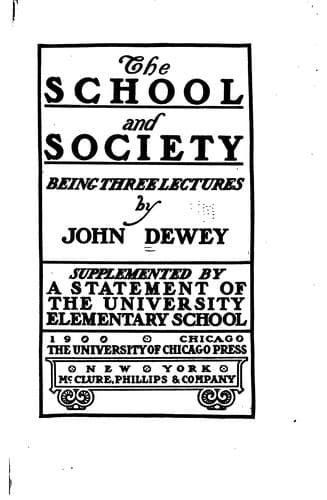
The School and Society: Being three lecturesDewey, John
Philosophy
The School and Society: Being three lectures
Dewey, John
Education; Education -- Philosophy; Educational psychology; University of Chicago. University Elementary School
No number of object-lessons, got up _as_ object-lessons for the sake of
giving information, can afford even the shadow of a substitute for
acquaintance with the plants and animals of the farm and garden,
acquired through actual living among them and caring for them. No
training of sense-organs in school, introduced for the sake of training,
can begin to compete with the alertness and fullness of sense-life that
comes through daily intimacy and interest in familiar occupations.
Verbal memory can be trained in committing tasks, a certain discipline
of the reasoning powers can be acquired through lessons in science and
mathematics; but, after all, this is somewhat remote and shadowy
compared with the training of attention and of judgment that is acquired
in having to do things with a real motive behind and a real outcome
ahead. At present, concentration of industry and division of labor have
practically eliminated household and neighborhood occupations—at least
for educational purposes. But it is useless to bemoan the departure of
the good old days of children’s modesty, reverence, and implicit
obedience, if we expect merely by bemoaning and by exhortation to bring
them back. It is radical conditions which have changed, and only an
equally radical change in education suffices. We must recognize our
compensations—the increase in toleration, in breadth of social judgment,
the larger acquaintance with human nature, the sharpened alertness in
reading signs of character and interpreting social situations, greater
accuracy of adaptation to differing personalities, contact with greater
commercial activities. These considerations mean much to the city-bred
child of today. Yet there is a real problem: how shall we retain these
advantages, and yet introduce into the school something representing the
other side of life—occupations which exact personal responsibilities and
which train the child with relation to the physical realities of life?
When we turn to the school, we find that one of the most striking
tendencies at present is toward the introduction of so-called manual
training, shop-work, and the household arts—sewing and cooking.
This has not been done “on purpose,” with a full consciousness that the
school must now supply that factor of training formerly taken care of in
the home, but rather by instinct, by experimenting and finding that such
work takes a vital hold of pupils and gives them something which was not
to be got in any other way. Consciousness of its real import is still so
weak that the work is often done in a half-hearted, confused, and
unrelated way. The reasons assigned to justify it are painfully
inadequate or sometimes even positively wrong.
Public-domain text, read in full here on John Shaqi.
Reviews
Reviews
No reviews yet
Be the first to share your thoughts on this work.
Join the Discussion
Join the discussion
Sign in to leave a comment or review.
Sign InorCreate an account