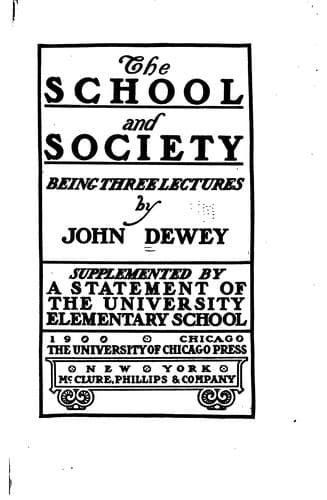
The School and Society: Being three lecturesDewey, John
Philosophy
The School and Society: Being three lectures
Dewey, John
Education; Education -- Philosophy; Educational psychology; University of Chicago. University Elementary School
4. Individual attention. This is secured by small groupings—eight or ten
in a class—and a large number of teachers supervising systematically the
intellectual needs and attainments and physical well-being and growth of
the child. To secure this we have now 135 hours of instructors’ time per
week, that is, the time of nine teachers for three hours per day, or one
teacher per group. It requires but a few words to make this statement
about attention to individual powers and needs, and yet the whole of the
school’s aims and methods, moral, physical, intellectual, are bound up
in it.
I think these four points present a fair statement of what we have set
out to discover. The school is often called an experimental school, and
in one sense that is the proper name. I do not like to use it too much,
for fear parents will think we are experimenting upon the children, and
that they naturally object to. But it is an experimental school—at least
I hope so—with reference to education and educational problems. We have
attempted to find out by trying, by doing—not alone by discussion and
theorizing—_whether_ these problems may be worked out, and _how_ they
may be worked out.
Next a few words about the means that have been used in the school in
order to test these four questions, and to supply their answers, and
first as to the place given to hand-work of different kinds in the
school. There are three main lines regularly pursued: (_a_) the
shop-work with wood and tools, (_b_) cooking work, and (_c_) work with
textiles—sewing and weaving. Of course, there is other hand-work in
connection with science, as science is largely of an experimental
nature. It is a fact that may not have come to your attention that a
large part of the best and most advanced scientific work involves a
great deal of manual skill, the training of the hand and eye. It is
impossible for one to be a first-class worker in science without this
training in manipulation, and in handling apparatus and materials. In
connection with the history work, especially with the younger children,
hand-work is brought in in the way of making implements, weapons, tools,
etc. Of course, the art work is another side—drawing, painting, and
modeling. Logically, perhaps, the gymnasium work does not come in here,
but as a means of developing moral and intellectual control through the
medium of the body it certainly does. The children have one-half hour
per day of this form of physical exercise. Along this line we have found
that hand-work, in large variety and amount, is the most easy and
natural method of keeping up the same attitude of the child in and out
of the school. The child gets the largest part of his acquisitions
through his bodily activities, until he learns to work systematically
with the intellect. That is the purpose of this work in the school, to
direct these activities, to systematize and organize them, so that they
shall not be as haphazard and as wandering as they are outside of
school.
Public-domain text, read in full here on John Shaqi.
Reviews
Reviews
No reviews yet
Be the first to share your thoughts on this work.
Join the Discussion
Join the discussion
Sign in to leave a comment or review.
Sign InorCreate an account