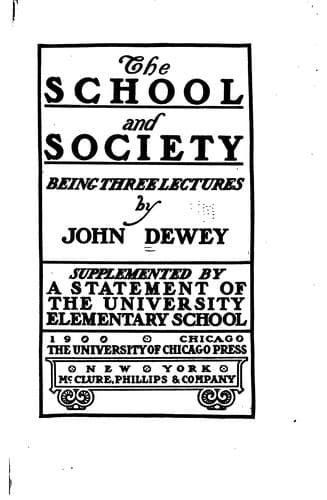
The School and Society: Being three lecturesDewey, John
Philosophy
The School and Society: Being three lectures
Dewey, John
Education; Education -- Philosophy; Educational psychology; University of Chicago. University Elementary School
Perhaps more attention, upon the whole, has been given to our second
point, that of positive subject-matter, than to any one other thing. On
the history side the curriculum is now fairly well worked out. The
younger children begin with the home and occupations of the home. In the
sixth year the intention is that the children should study occupations
outside the home, the larger social industries—farming, mining, lumber,
etc.—that they may see the complex and various social industries on
which life depends, while incidentally they investigate the use of the
various materials—woods, metals, and the processes applied—thus getting
a beginning of scientific study. The next year is given to the
historical development of industry and invention—starting with man as a
savage and carrying him through the typical phases of his progress
upward, until the iron age is reached and man begins to enter upon a
civilized career. The object of the study of primitive life is not to
keep the child interested in lower and relatively savage stages, but to
show him the steps of progress and development, especially along the
line of invention, by which man was led into civilization. There is a
certain nearness, after all, in the child to primitive forms of life.
They are much more simple than existing institutions. By throwing the
emphasis upon the progress of man, and upon the way advance has been
made, we hope to avoid the objections that hold against paying too much
attention to the crudities and distracting excitements of savage life.
The next two or three years, _i. e._, the fourth and fifth grades, and
perhaps the sixth, will be devoted to American history. It is then that
history, properly speaking, begins, as the study of primitive life can
hardly be so called.
Then comes Greek history and Roman, in the regular chronological order,
each year having its own work planned with reference to what has come
before and after.
The science work was more difficult to arrange and systematize, because
there was so little to follow—so little that has been already done in an
organized way. We are now at work upon a program,[2] and I shall not
speak in detail about it. The first two or three years cultivate the
children’s powers of observation, lead them to sympathetic interest in
the habits of plants and animals, and to look at things with reference
to their uses. Then the center of the work becomes geographical—the
study of the earth, as the most central thing. From this almost all the
work grows out, and to it the work goes back. Another standpoint in the
science work is that of the application of natural forces to the service
of man through machines. Last year a good deal of work was done in
electricity (and will be repeated this year), based on the telegraph and
telephone—taking up the things that can easily be grasped.
Footnote 2:
This year’s program is published in the _Elementary School Record_.
Address The University of Chicago Press for particulars.
Public-domain text, read in full here on John Shaqi.
Reviews
Reviews
No reviews yet
Be the first to share your thoughts on this work.
Join the Discussion
Join the discussion
Sign in to leave a comment or review.
Sign InorCreate an account