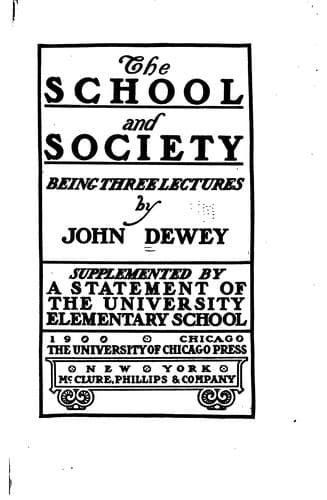
The School and Society: Being three lecturesDewey, John
Philosophy
The School and Society: Being three lectures
Dewey, John
Education; Education -- Philosophy; Educational psychology; University of Chicago. University Elementary School
In mechanics they have studied locks and clocks with reference to the
adaptation of the various parts of the machinery. All this work makes a
most excellent basis for more formal physics later on. Cooking gives
opportunity for getting a great many ideas of heat and water, and of
their effects. The scientific work taken up in the school differs mainly
from that of other schools in having the experimental part—physics and
chemistry—emphasized, and is not confined simply to nature study—the
study of plants and animals. Not that the latter is less valuable, but
that we find it possible to introduce the physical aspects from the
first.
If I do not spend a large amount of time in speaking of the music and
art work, it is not because they are not considered valuable and
important—certainly as much so as any other work done in the school, not
only in the development of the child’s moral and æsthetic nature, but
also from a strictly intellectual point of view. I know of no work in
the school that better develops the power of attention, the habit of
observation and of consecutiveness, of seeing parts in relation to a
whole.
I shall now say a few words about the administrative side of the school.
At the outset we mixed up the children of different ages and attainments
as much as possible, believing there were mental advantages in the
give-and-take thus secured, as well as the moral advantages in having
the older assume certain responsibilities in the care of the younger. As
the school grew, it became necessary to abandon the method, and to group
the children with reference to their common capacities. These groupings,
however, are based, not on ability to read and write, but upon
similarity of mental attitude and interest, and upon general
intellectual capacity and mental alertness. There are ways in which we
are still trying to carry out the idea of mixing up the children, that
we may not build the rigid stepladder system of the “graded” school. One
step in this direction is having the children move about and come in
contact with different teachers. While there are difficulties and evils
connected with this, I think one of the most useful things in the school
is that children come into intimate relation with a number of different
personalities. The children also meet in general assemblies—for singing,
and for the report of the whole school work as read by members of the
different groups. The older children are also given a half hour a week
in which to join some of the younger groups, and, if possible, as in
hand-work, enter into the work of the younger children. In various ways
we are attempting to keep a family spirit throughout the school, and not
the feeling of isolated classes and grades.
Public-domain text, read in full here on John Shaqi.
Reviews
Reviews
No reviews yet
Be the first to share your thoughts on this work.
Join the Discussion
Join the discussion
Sign in to leave a comment or review.
Sign InorCreate an account