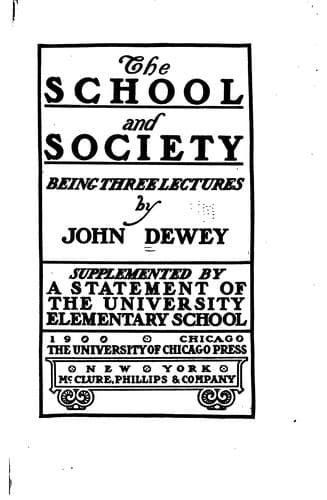
The School and Society: Being three lecturesDewey, John
Philosophy
The School and Society: Being three lectures
Dewey, John
Education; Education -- Philosophy; Educational psychology; University of Chicago. University Elementary School
The organization of the teaching force has gradually become
departmental, as the needs of the work have indicated its chief
branches. So we now have recognized divisions of Science, History,
Domestic or Household Arts, Manual Training in the limited sense (wood
and metals), Music, Art (that is, drawing, water colors, clay modeling,
etc.), and Gymnasium. As the work goes on into the secondary period, the
languages and mathematics will also of necessity assume a more
differentiated and distinct position. As it is sometimes said that
correlated or thoroughly harmonized work cannot be secured upon this
basis, I am happy to say that our experience shows positively that there
are no intrinsic difficulties. Through common devotion to the best
development of the child, through common loyalty to the main aims and
methods of the school, our teachers have demonstrated that in education,
as in business, the best organization is secured through proper regard
for natural divisions of labor, interest, and training. The child
secures the advantage in discipline and knowledge of contact with
experts in each line, while the individual teachers serve the common
thought in diverse ways, thus multiplying and reinforcing it.
Upon the moral side, that of so-called discipline and order, where the
work of the University Elementary School has perhaps suffered most from
misunderstanding and misrepresentation, I shall say only that our ideal
has been, and continues to be, that of the best form of family life,
rather than that of a rigid graded school. In the latter, the large
number of children under the care of a single teacher, and the very
limited number of modes of activity open to the pupils, have made
necessary certain fixed and somewhat external forms of “keeping order.”
It would be very stupid to copy these, under the changed conditions of
our school, its small groups permitting and requiring the most intimate
personal acquaintance of child and teacher, and its great variety of
forms of work, with their differing adaptations to the needs of
different children. If we have permitted to our children more than the
usual amount of freedom, it has not been in order to relax or decrease
real discipline, but because under our particular conditions larger and
less artificial responsibilities could thus be required of the children,
and their entire development of body and spirit be more harmonious and
complete. And I am confident that the parents who have intrusted their
children to us for any length of time will agree in saying that, while
the children like, or love, to come to school, yet work, and not
amusement, has been the spirit and teaching of the school; and that this
freedom has been granted under such conditions of intelligent and
sympathetic oversight as to be a means of upbuilding and strengthening
character.
Public-domain text, read in full here on John Shaqi.
Reviews
Reviews
No reviews yet
Be the first to share your thoughts on this work.
Join the Discussion
Join the discussion
Sign in to leave a comment or review.
Sign InorCreate an account