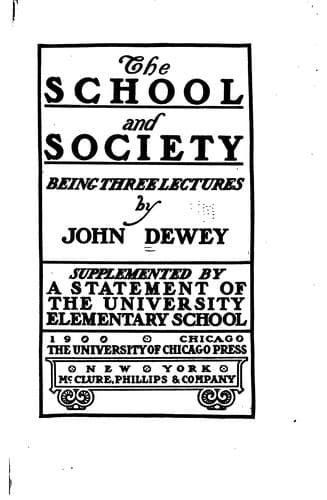
The School and Society: Being three lecturesDewey, John
Philosophy
The School and Society: Being three lectures
Dewey, John
Education; Education -- Philosophy; Educational psychology; University of Chicago. University Elementary School
The difference that appears when occupations are made the articulating
centers of school life is not easy to describe in words; it is a
difference in motive, of spirit and atmosphere. As one enters a busy
kitchen in which a group of children are actively engaged in the
preparation of food, the psychological difference, the change from more
or less passive and inert recipiency and restraint to one of buoyant
outgoing energy, is so obvious as fairly to strike one in the face.
Indeed, to those whose image of the school is rigidly set the change is
sure to give a shock. But the change in the social attitude is equally
marked. The mere absorption of facts and truths is so exclusively
individual an affair that it tends very naturally to pass into
selfishness. There is no obvious social motive for the acquirement of
mere learning, there is no clear social gain in success thereat. Indeed,
almost the only measure for success is a competitive one, in the bad
sense of that term—a comparison of results in the recitation or in the
examination to see which child has succeeded in getting ahead of others
in storing up, in accumulating the maximum of information. So thoroughly
is this the prevalent atmosphere that for one child to help another in
his task has become a school crime. Where the school work consists in
simply learning lessons, mutual assistance, instead of being the most
natural form of coöperation and association, becomes a clandestine
effort to relieve one’s neighbor of his proper duties. Where active work
is going on all this is changed. Helping others, instead of being a form
of charity which impoverishes the recipient, is simply an aid in setting
free the powers and furthering the impulse of the one helped. A spirit
of free communication, of interchange of ideas, suggestions, results,
both successes and failures of previous experiences, becomes the
dominating note of the recitation. So far as emulation enters in, it is
in the comparison of individuals, not with regard to the quantity of
information personally absorbed, but with reference to the quality of
work done—the genuine community standard of value. In an informal but
all the more pervasive way, the school life organizes itself on a social
basis.
Public-domain text, read in full here on John Shaqi.
Reviews
Reviews
No reviews yet
Be the first to share your thoughts on this work.
Join the Discussion
Join the discussion
Sign in to leave a comment or review.
Sign InorCreate an account