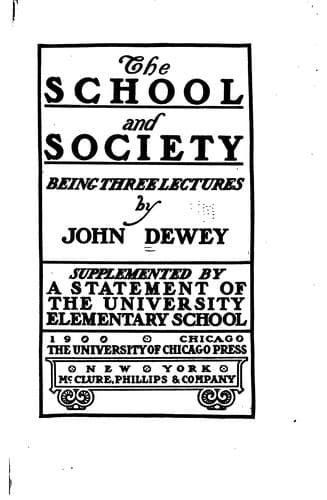
The School and Society: Being three lectures — John Shaqi
The School and Society: Being three lecturesDewey, John
Philosophy
The School and Society: Being three lectures
Dewey, John
Education; Education -- Philosophy; Educational psychology; University of Chicago. University Elementary School
If we were to cross-examine even those who are most favorably disposed
to the introduction of this work into our school system, we should, I
imagine, generally find the main reasons to be that such work engages
the full spontaneous interest and attention of the children. It keeps
them alert and active, instead of passive and receptive; it makes them
more useful, more capable, and hence more inclined to be helpful at
home; it prepares them to some extent for the practical duties of later
life—the girls to be more efficient house managers, if not actually
cooks and sempstresses; the boys (were our educational system only
adequately rounded out into trade schools) for their future vocations. I
do not underestimate the worth of these reasons. Of those indicated by
the changed attitude of the children I shall indeed have something to
say in my next talk, when speaking directly of the relationship of the
school to the child. But the point of view is, upon the whole,
unnecessarily narrow. We must conceive of work in wood and metal, of
weaving, sewing, and cooking, as methods of life not as distinct
studies.
We must conceive of them in their social significance, as types of the
processes by which society keeps itself going, as agencies for bringing
home to the child some of the primal necessities of community life, and
as ways in which these needs have been met by the growing insight and
ingenuity of man; in short, as instrumentalities through which the
school itself shall be made a genuine form of active community life,
instead of a place set apart in which to learn lessons.
A society is a number of people held together because they are working
along common lines, in a common spirit, and with reference to common
aims. The common needs and aims demand a growing interchange of thought
and growing unity of sympathetic feeling. The radical reason that the
present school cannot organize itself as a natural social unit is
because just this element of common and productive activity is absent.
Upon the playground, in game and sport, social organization takes place
spontaneously and inevitably. There is something to do, some activity to
be carried on, requiring natural divisions of labor, selection of
leaders and followers, mutual coöperation and emulation. In the
schoolroom the motive and the cement of social organization are alike
wanting. Upon the ethical side, the tragic weakness of the present
school is that it endeavors to prepare future members of the social
order in a medium in which the conditions of the social spirit are
eminently wanting.
Public-domain text, read in full here on John Shaqi.
Reviews
Reviews
No reviews yet
Be the first to share your thoughts on this work.
Join the Discussion
Join the discussion
Sign in to leave a comment or review.
Sign InorCreate an account