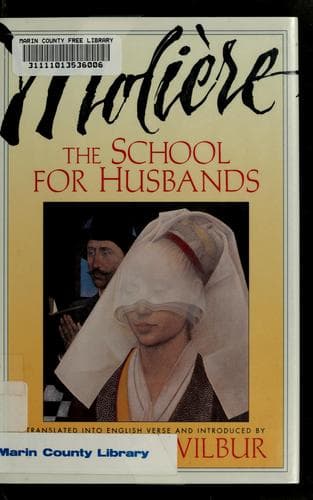
Comedy plays; French drama -- 17th century -- Translations into English; Molière, 1622-1673 -- Translations into English
Murphy, in _The School for Guardians_, has borrowed from three
plays of Molière. The main plot is taken from _The School for
Wives_; some incidents of the second act are taken from _The
Blunderer_ (see Introductory Notice to _The Blunderer_), but the
scenes in which Oldcastle and Lovibond state their intention of marrying
their wards, and the way in which one of the wards, Harriet, makes her
love known to Belford is taken from _The School for Husbands_,
though Leonor does not betray in the French comedy, as she does in the
English, the confidence placed in her. The French Isabella acts like
Harriet, but then she has a foolish and jealous guardian.
Wycherley in _The Country Wife_, probably acted in 1672 or 1673,
and which is partly an imitation of Molière's _School for Wives_,
has borrowed from _The School for Husbands_, the letter which
Isabella writes to Valère (Act ii., Scene 8), and also the scene in
which Isabella escapes disguised in her sister's clothes: but, of
course, to give an additional zest to the English play, the author makes
Pinchwife himself bring his wife to her lover, Horner. The scene hardly
bears transcribing. He has also partly imitated in _The Gentleman
Dancing-Master_, first performed in 1673, some scenes of _The
School for Husbands_.
Otway, in _The Soldier's Fortune_ (see Introductory Notice to
_Sganarelle, or The Self-Deceived Husband_), has borrowed from
Molière's _School for Husbands_ that part of his play in which Lady
Dunse makes her husband the agent for conveying a ring and a letter to
her lover.
DRAMATIS PERSONÆ.
SGANARELLE, [Footnote: This part was played by Molière himself.
In the inventory taken after Molière's death, and given by M. Soulié,
we find: "A dress for _The School for Husbands_, consisting of
breeches, doublet, cloak, collar, purse and girdle, all of a kind of
brown coloured (_couleur de muse_) satin."]
}
} _brothers_.
ARISTE, )
VALÈRE, _lover to Isabella_.
ERGASTE, _servant to Valère_.
A MAGISTRATE.
[Footnote: The original has _un Commissaire_, who in Molière's
time, appears to have been a kind of inferior magistrate under the
authority of the _Lieutenant-général de la Police_.
The _Commissaires de Police_ were not established till 1699;
and _The School for Husbands_ was played for the first time in 1661.]
A NOTARY.
ISABELLA, )
) _sisters_.
LÉONOR, }
LISETTE, _maid to Isabella_.
_Scene_.--A PUBLIC PLACE IN PARIS.
THE SCHOOL FOR HUSBANDS.
(_L'ECOLE DES MARIS_).
* * * * *
ACT I.
SCENE I.--SGANARELLE, ARISTE.
SGAN. Pray, brother, let us talk less, and let each of us live as he
likes. Though you have the advantage of me in years, and are old enough
to be wise, yet I tell you that I mean to receive none of your reproofs;
that my fancy is the only counsellor I shall follow, and that I am quite
satisfied with my way of living.
AR. But every one condemns it.
Public-domain text, read in full here on John Shaqi.
Reviews
Reviews
No reviews yet
Be the first to share your thoughts on this work.
Join the Discussion
Join the discussion
Sign in to leave a comment or review.
Sign InorCreate an account