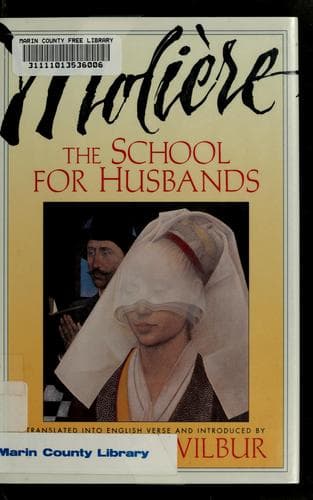
Comedy plays; French drama -- 17th century -- Translations into English; Molière, 1622-1673 -- Translations into English
SGAN. Yes, fools like yourself, brother.
AR. Thank you very much. It is a pleasant compliment.
SGAN. I should like to know, since one ought to hear everything, what
these fine critics blame in me.
AR. That surly and austere temper which shuns all the charms of society,
gives a whimsical appearance to all your actions, and makes everything
peculiar in you, even your dress.
SGAN. I ought then to make myself a slave in fashion, and not to put on
clothes for my own sake? Would you not, my dear elder brother--for,
Heaven be thanked, so you are, to tell you plainly, by a matter of
twenty years; and that is not worth the trouble of mentioning--would you
not, I say, by your precious nonsense, persuade me to adopt the fashions
of those young sparks of yours?
[Footnote: The original has _vos jeunes muguets_, literally "your
young lilies of the valley," because in former times, according to some
annotators, the courtiers wore natural or artificial lilies of the
valley in their buttonholes, and perfumed themselves with the essence of
that flower. I think that _muguet_ is connected with the old French
word _musguet_, smelling of musk. In Molière's time _muguet_
had become rather antiquated; hence it was rightly placed in the mouth
of Sganarelle, who likes to use such words and phrases. Rabelais employs
it in the eighth chapter of _Gargantua, un tas de muguets_, and it
has been translated by Sir Thomas Urquhart as "some fond wooers and
wench-courters." The fashion of calling dandies after the name of
perfumes is not rare in France. Thus Regnier speaks of them as
_marjolets_, from _marjolaine_, sweet marjoram; and Agrippa
d'Aubigné calls them _muscadins_ (a word also connected with the
old French _musguet_), which name was renewed at the beginning of
the first French revolution, and bestowed on elegants, because they
always smelled of musk.]
Oblige me to wear those little hats which provide ventilation for their
weak brains, and that flaxen hair, the vast curls whereof conceal the
form of the human face;
[Footnote: The fashion was in Molière's time to wear the hair, or wigs,
very long, and if possible of a fair colour, which gave to the young
fashionables, hence called _blondins_, an effeminate air.
Sganarelle addresses Valère (Act ii. Scene 9), likewise as _Monsieur
aux blonds cheveux_. In _The School for Wives_ (Act ii. Scene
6), Arnolphe also tells Agnès not to listen to the nonsense of these
_beaux blondins_. According to Juvenal (Satire VI.) Messalina put a
fair wig on to disguise herself. Louis XIV. did not begin to wear a wig
until 1673.]
Public-domain text, read in full here on John Shaqi.
Reviews
Reviews
No reviews yet
Be the first to share your thoughts on this work.
Join the Discussion
Join the discussion
Sign in to leave a comment or review.
Sign InorCreate an account