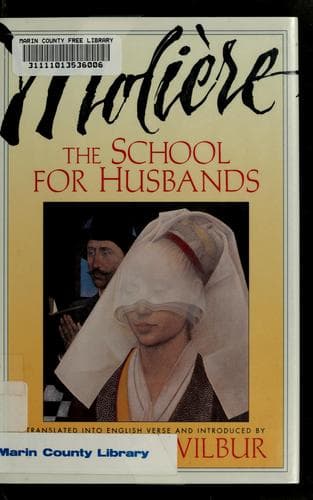
Comedy plays; French drama -- 17th century -- Translations into English; Molière, 1622-1673 -- Translations into English
those little doublets but just below the arms, and those big collars
falling down to the navel; those sleeves which one sees at table trying
all the sauces, and those petticoats called breeches; those tiny shoes,
covered with ribbons, which make you look like feather-legged pigeons;
and those large rolls wherein the legs are put every morning, as it were
into the stocks, and in which we see these gallants straddle about with
their legs as wide apart, as if they were the beams of a mill?
[Footnote: The original has _marcher écarquillés ainsi que des
volants_. Early commentators have generally stated that
_volants_ means here "the beams of a mill," but MM. Moland and E.
Despois, the last annotators of Molière, maintain that it stands for
"shuttlecock," because the large rolls (_canons_), tied at the knee
and wide at the bottom, bore a great resemblance to shuttlecocks turned
upside down. I cannot see how this can suit the words _marcher
écarquillés_, for the motion of the _canons_ of gallants,
walking or straddling about, is very unlike that produced by
shuttlecocks beaten by battledores; I still think "beams of a mill"
right, because, though the _canons_ did not look like beams of a
mill, the legs did, when in motion.]
I should doubtless please you, bedizened in this way; I see that you
wear the stupid gewgaws which it is the fashion to wear.
AR. We should always agree with the majority, and never cause ourselves
to be stared at. Extremes shock, and a wise man should do with his
clothes as with his speech; avoid too much affectation, and without
being in too great a hurry, follow whatever change custom introduces. I
do not think that we should act like those people who always exaggerate
the fashion, and who are annoyed that another should go further than
themselves in the extremes which they affect; but I maintain that it is
wrong, for whatever reasons, obstinately to eschew what every one
observes; that it would be better to be counted among the fools than to
be the only wise person, in opposition to every one else.
SGAN. That smacks of the old man who, in order to impose upon the world,
covers his grey hairs with a black wig.
AR. It is strange that you should be so careful always to fling my age
in my face, and that I should continually find you blaming my dress as
well as my cheerfulness. One would imagine that old age ought to think
of nothing but death, since it is condemned to give up all enjoyment;
and that it is not attended by enough ugliness of its own, but must
needs be slovenly and crabbed.
SGAN. However that may be, I am resolved to stick to my way of dress. In
spite of the fashion, I like my cap so that my head may be comfortably
sheltered beneath it; a good long doublet buttoned close, as it should
be,
[Footnote: The young dandies in the beginning of the reign of Louis
XIV., wore slashed doublets, very tight and short.]
Public-domain text, read in full here on John Shaqi.
Reviews
Reviews
No reviews yet
Be the first to share your thoughts on this work.
Join the Discussion
Join the discussion
Sign in to leave a comment or review.
Sign InorCreate an account