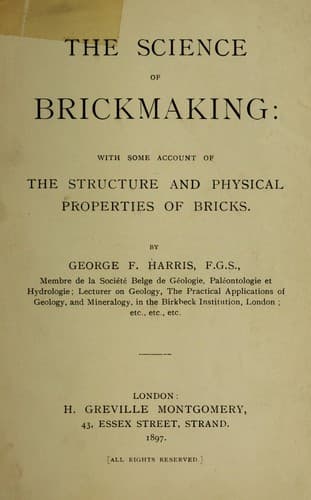
The Science of BrickmakingHarris, George Frederick
Science
The Science of Brickmaking
Harris, George Frederick
Brickmaking -- Handbooks, manuals, etc.
We have been intensely amused to note the efforts in recent years
to obtain possession of a few acres of this coveted deposit for
brickmaking in divers localities. Not long since we visited a large
brickmaking establishment where these Reading plastic clays are
actively raised and used, the works being situated four miles from the
nearest railway. There were no other brickworks between it and the
railway line, and there was no water accommodation. Enquiry revealed
the fact that the greater part of the intervening land belonged to the
same landowner as the ground where the brickyard stands, and that no
difficulty was apprehended of the owner letting out such intervening
land for the same uses and on the same terms if other brickyards were
contemplated. The proprietor of the brickyard in question volunteered
the information that the reason he started so far from the railway was
because the earth at the point selected was the only kind suitable for
brickmaking in the neighbourhood. We then questioned him as to his
knowledge of the brick-earths in the district, and eventually elicited
the fact that he chanced upon the spot selected, without any reasoning
therefor, and commenced operations. As a matter of fact, precisely the
same clay extended from his works all the way to the railway line, and
had he known anything whatever of the geology of the district (even
the merest boy’s knowledge of the subject), he would have seen how to
save that four miles of road carriage. What prevented him from knowing
the fact was a thin mantle of gravel and soil about four feet in
thickness, which covered the plastic clay in the area generally, except
in the immediate vicinity of his brickyard. That was in reference to a
lacustrine deposit--the Reading plastic clay--and shows the value of
knowing something of its persistent character; if it had been a river
deposit there would not have been so much room for wonderment.
To give some idea of the extent of that particular horizon, we may
say that not only is the plastic clay alluded to found so extensively
in the London and Hampshire basins, it is even more expanded in the
north-eastern parts of France, and is there as much utilised as on this
side of the Channel for brickmaking.
Public-domain text, read in full here on John Shaqi.
Reviews
Reviews
No reviews yet
Be the first to share your thoughts on this work.
Join the Discussion
Join the discussion
Sign in to leave a comment or review.
Sign InorCreate an account