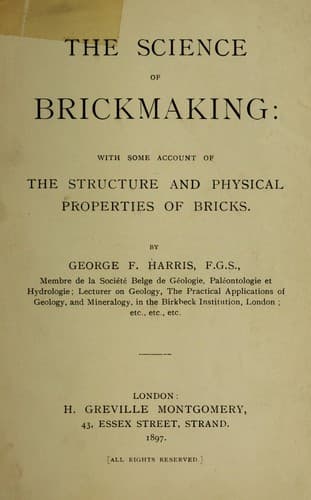
The Science of BrickmakingHarris, George Frederick
Science
The Science of Brickmaking
Harris, George Frederick
Brickmaking -- Handbooks, manuals, etc.
Lacustrine deposits are sometimes of enormous value to the clayworker,
on account of the general purity of the clays. This is more
particularly the case when the material deposited is in part or wholly
derived from chemical disintegration of granitic rocks, as in the
celebrated Bovey Heathfield clays near Newton Abbot, so well described
in a small pamphlet by Mr. S. Smith Harvey. Here an experimental boring
proved the clays to a depth of 130 feet with no signs of exhaustion.
In the divers clay-pits but a small proportion of waste is found,
the different levels vary in composition, and, like almost all thick
clays, improve in quality as the depth increases. The strata are very
irregular towards the surface, due perhaps to the action of local
freshets in the final periods of the history of the lake. These clays
are extensively employed for the manufacture of stoneware pipes,
facing and other bricks, fire-bricks, etc. They constitute a somewhat
remarkable exception to the class of clays laid down in lakes, as a
rule, and, as will have been observed, are of enormous thickness.
We have very little to say in regard to estuarine brick-earths; as
might readily be anticipated, they are intermediate in character
between fluviatile and marine deposits, and approach the one or
the other according to position in the estuary. On the whole, they
are variable in character, individual beds being thin. The strata
frequently contain abundant plant remains (pieces of wood, etc.), and,
except in the case of large rivers, are not noted for yielding very
good brick-earths. Sometimes, however, the quality of the clays is not
bad, as instance the bricks made in Lincolnshire and Northamptonshire
from Jurassic Estuarine clays.
CHAPTER III.
MARINE BRICK-EARTHS.
Public-domain text, read in full here on John Shaqi.
Reviews
Reviews
No reviews yet
Be the first to share your thoughts on this work.
Join the Discussion
Join the discussion
Sign in to leave a comment or review.
Sign InorCreate an account