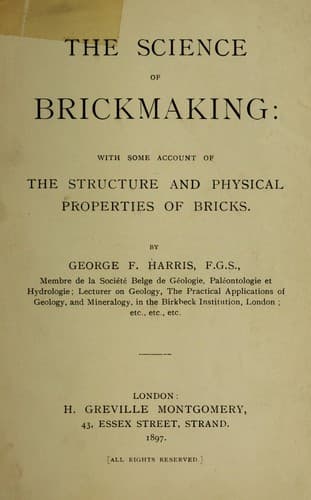
The Science of BrickmakingHarris, George Frederick
Science
The Science of Brickmaking
Harris, George Frederick
Brickmaking -- Handbooks, manuals, etc.
And this seems a fitting opportunity to the writer to put on record
the fact that many of the most wonderful remains found in the Oxford
Clay and the neighbouring Kimeridge Clay are due to the discoveries
of brickmakers. Without their valuable aid scientists would be quite
unable to clearly depict the life of those remote epochs. We have
mentioned Peterborough; some most interesting remains have been found
in the clays near that town during the past few years. To appreciate
this let the reader visit the fossil reptile gallery of the British
Museum (Natural History), at South Kensington. One of the most recent
acquisitions, set up a year or two ago, is the skeleton of a young
_Plesiosaurus_--without doubt the most perfect specimen in the world of
its kind--from Peterborough. The _Plesiosaurus_ was a large swimming
reptile, with paddles, and a long neck.
We mention these things not only to instil philosophical interest in
such brick-earths, which may be reflected upon after business hours,
but to impart some idea of the extreme remoteness of the epoch from the
human point of view, and to insist on the immensity of the intervening
time throughout which circulating underground waters--even in such an
impervious material as stiff clay--may have exerted chemical action.
The “mineralisation” of the fossils is an eloquent witness of the
effect of such changes. The reader will perceive from this that there
is scant possibility of soluble salts being present in such marine
clays; and the geological circumstances are fully borne out by the
results of hundreds of chemical analyses of thick marine clays.
The invertebrate fossils more particularly testify to the marine
origin of the clays, and are thus invested with considerable practical
interest. The man whose duty it is to determine the persistence, or
otherwise, of valuable marine brick-earths has thus a much easier task
than when called upon to decide the value of a large tract of land for
brickmaking purposes, of fluviatile origin. Finally, brick-earths do
not, except in extremely rare instances, vary materially in character
when dug into horizontally, thus every opportunity is afforded to
the manufacturer for making an unvariable quality brick, tile, or
drain pipe. It should be borne in mind, however, that these clays
often weather a brown colour, which on being dug into changes to a
bluish-black tint, the latter being the unaltered and best portion as
a rule. The only practical advantage the worker of a superficial river
deposit possesses over his neighbour using thick marine clay is in the
great range of variation in materials disclosed in the former kind of
pit. By judiciously mixing the different beds he may be able to live
well where the worker of marine clays, especially where the clay is
too stiff, or contains too much lime, “comes to grief.” A good marine
clay is a great boon, a bad one cannot be remedied other than by the
sacrifice of much money.
CHAPTER IV.
Public-domain text, read in full here on John Shaqi.
Reviews
Reviews
No reviews yet
Be the first to share your thoughts on this work.
Join the Discussion
Join the discussion
Sign in to leave a comment or review.
Sign InorCreate an account