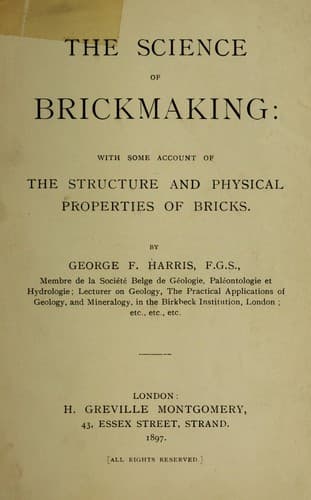
The Science of BrickmakingHarris, George Frederick
Science
The Science of Brickmaking
Harris, George Frederick
Brickmaking -- Handbooks, manuals, etc.
THE MINERAL CONSTITUTION OF BRICK-EARTHS.
There cannot be any question that the applicability or otherwise, of
an earth for making good bricks, to a large extent depends on the
mineral constitution of that earth. A chemical analysis of a sample
of such earth will tell us how much silica, alumina, lime, iron,
etc., is present therein, and this information is frequently of great
value when given by a scientific chemist; but it does not tell us the
state in which those constituents exist in the earth--an essential
_desideratum_, if we are to understand the scientific aspects of the
question of burning in the kiln. Further, the size of the granules
and particles composing the earth is well worth knowing, as we shall
presently see. It is a great mistake to imagine that all clays are
essentially chemical deposits. The majority of them have been in part
derived from chemical disintegration, it is true; but the resulting
deposits contain so much also that is purely of mechanical origin, that
the behaviour of the whole is materially modified, from a metallurgical
point of view. Take one ingredient, for example--say, silica. That
may exist in a brick-earth in a variety of ways, both in a free and
combined state; but its behaviour in the kiln is largely dependent on
the particular form assumed, not only whether it is free or combined,
but as to how it is combined. In a certain sense, it is very doubtful
whether even in the best-burnt brick much of the raw material becomes
chemically combined; a sort of agglutination takes place locally, as is
clearly shown by the microscope; at such points true fusion undoubtedly
takes place, and there may be actual chemical combination. In the vast
majority of cases, however, such fusion or possible combination is of
an extremely partial and elementary character, whilst it hardly exists
in the average “rubber.” The microscope shows that even in the hardest
burnt brick there still remain enormous quantities of what may be
termed mineral grains, that have by no means succumbed to the burning
process. The edges of the grains may occasionally be seen merging into
the more or less vitreous ground mass in which they are embedded, but
beyond that they appear tolerably fresh, and their action on polarised
light remains unimpaired.
Public-domain text, read in full here on John Shaqi.
Reviews
Reviews
No reviews yet
Be the first to share your thoughts on this work.
Join the Discussion
Join the discussion
Sign in to leave a comment or review.
Sign InorCreate an account