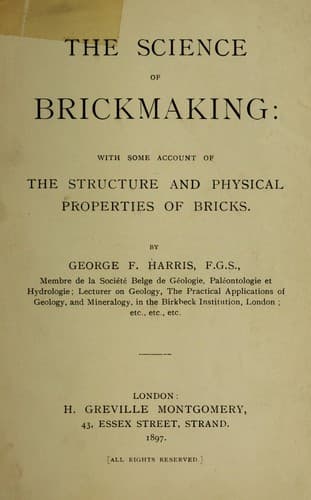
The Science of BrickmakingHarris, George Frederick
Science
The Science of Brickmaking
Harris, George Frederick
Brickmaking -- Handbooks, manuals, etc.
But the mineral matter called kaolin in ordinary clays, such as the
brown and blue London Clay, the Oxford Clay, “brick-earths,” etc.,
has very little in common with the more or less pure china-clay. The
microscope shows that in the vast majority of such clays scales of true
kaolin are few and far between, that opaque mud particles are more
frequent, and, above all, that pieces of highly decomposed felspar
(called “kaolinised” matter) are present. Eliminating all other and
foreign substances from the clay, the whole of what would commonly be
called kaolin and kaolinised matter, taken together, is of very varied
chemical composition, and might, indeed, be fusible in the ordinary
sense of that term. From this, the reader will perceive that the term
kaolin is very ambiguous and altogether too wide in its meaning. We
think it highly desirable, therefore, to describe kaolin as a true
mineral and not as a rock, reserving the term for the crystalline
plates. The mud particles referred to we may call “kaolinised
particles;” and the highly decomposed felspar “kaolinised matter.” To
sum up the relative fusibility of these substances, _per se_, we should
say that (1) kaolin crystals are practically infusible; (2) kaolinised
particles are either fusible, partly fusible, or infusible, depending
on the actual nature of the particles; and (3) that kaolinised matter
may be difficultly fusible or infusible. A mixture of (1) and (2) may
not be fusible, and could not be unless a great proportion of (2) of a
fusible character, so as to form a flux, were present. The reasons for
this will appear in considering the different kinds of felspar, next to
be described.
FELSPAR.
This mineral, a very common constituent of nearly all clays and
brick-earths is very variable in character, but may be separated into a
number of mineral species, each of which possesses a definite structure
and a more or less constant chemical composition. To show the range
of variation, the following kinds of felspar, with their chemical
composition, may be quoted:--[3]
_Chemical Composition of Felspars._
-------------+---------+----------+---------+-------+-------
| Silica. | Alumina. | Potash. | Soda. | Lime.
+---------+----------+---------+-------+-------
Orthoclase | 64.6 | 18.5 | 16.9 | |
Albite | 68.6 | 19.5 | | 11.8 |
Oligoclase | 63.7 | 23.9 | 1.20 | 8.1 | 2.0
Labradorite | 52.9 | 30.3 | | 4.5 | 12.3
Anorthite | 43.0 | 36.8 | | | 20.1
-------------+---------+----------+---------+-------+-------
Public-domain text, read in full here on John Shaqi.
Reviews
Reviews
No reviews yet
Be the first to share your thoughts on this work.
Join the Discussion
Join the discussion
Sign in to leave a comment or review.
Sign InorCreate an account