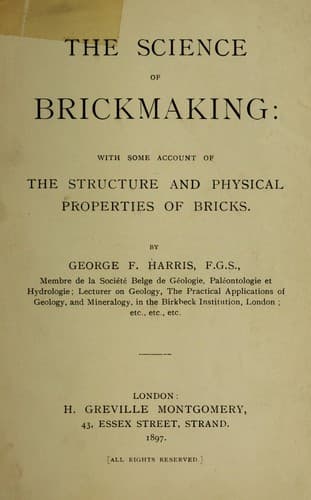
The Science of BrickmakingHarris, George Frederick
Science
The Science of Brickmaking
Harris, George Frederick
Brickmaking -- Handbooks, manuals, etc.
is introduced into certain china-clays, which render them different
in their behaviour under intense heat from those china-clays in which
orthoclase alone has been principally concerned. In other words,
great practical advantages accrue from an accurate knowledge of the
constitution and origin of the china-clays in question. Two clays of
the same chemical composition often behave in a different manner in the
kiln; the cause of this is frequently to be found in the prevalence of
“mechanical fragments” of felspar in one of the clays; and the absence
of these, but the presence of “kaolinised particles” of the same
chemical composition, in the other.
Another point to which we may draw attention is the erroneous
supposition that granites which have yielded china-clay have in all
instances been reduced to the condition in which we now find them by
the action of atmospheric agents of denudation alone. Granites, as a
matter of fact, yield very slowly to the action of the atmosphere,
and taken as a whole no building stone is as durable as they. How
comes it, then, that they have decomposed to such an extent as to
have formed extensive deposits of china-clay in a very short space of
time, geologically? We think the answer is to be sought, at any rate
in some instances, in the alteration the rock as a whole has undergone
in certain situations, whereby it became more easily decomposable.
Take the rotten china-stone of the neighbourhood of St. Austell, for
example. In that material we clearly see a stone from which the “life”
has been sapped, and instead of a bright, sparkling, porphyritic
granite, as it once was, we now notice only a ghost of its former self.
The large orthoclase felspars may be seen in it as skeletons, the
mica is reduced to mere iron-stains (when present at all), whilst the
quartz is also slightly affected. This altered and comparatively rotten
material (although sometimes hard enough to be used as building stone)
extends to an enormous depth from the surface; it has not been bottomed
in some parts of the district. Such an extensive transformation could
not possibly be due to ordinary agents of denudation which do their
work at and near the surface of the rock only. It seems to arise from
an enormous regional alteration, acting underground to an unfathomable
depth, and which may not be unconnected with the mineral veins so
common in, and in the immediate vicinity of the workings.[4]
Public-domain text, read in full here on John Shaqi.
Reviews
Reviews
No reviews yet
Be the first to share your thoughts on this work.
Join the Discussion
Join the discussion
Sign in to leave a comment or review.
Sign InorCreate an account