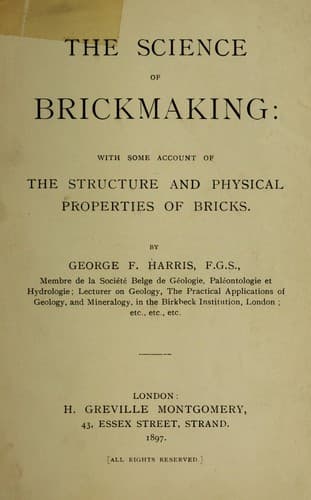
The Science of BrickmakingHarris, George Frederick
Science
The Science of Brickmaking
Harris, George Frederick
Brickmaking -- Handbooks, manuals, etc.
Yet another thing to be remembered is that, under certain conditions,
as near St. Austell, china-clay has been formed _in situ_, and has
therefore not been deposited by the action of running water, as have
the majority of china and other clays. Mr. Collins remarks that this
china-clay is very irregular in its occurrence. It seems to be formed
of various granite masses decomposed in place; it often occupies
considerable surface areas, and extends to a depth unknown. He remarks
that at Beam mine, and also at Rocks mine, both near St. Austell,
china-clay was found to a depth considerably exceeding 60 fathoms from
the surface. This china-clay, in its natural condition, is very much
the same as china-stone; but the decomposition has proceeded further,
the felspar being completely changed into clay; and nothing more is
necessary for extracting the clay than the disintegration of the whole
mass by a stream of water directed upon it, when the clay is carried
away in suspension and collected at convenient spots. Thus there is
every gradation between the true crystalline orthoclase and triclinic
felspars, through china-stone into china-clay formed _in situ_, so
into china-clay deposited from water by natural or artificial means,
and into a pure clay containing a large proportion of kaolin crystals,
“kaolinised particles” and “kaolinised matter.” But although we can
state that much, a great deal yet remains to be done in connecting
mineral structure with chemical composition of the purer clays, and
in defining the various grades scientifically, in order that full
advantage may be derived from them in a commercial sense.
CHAPTER V.
MINERALS: THEIR BEHAVIOUR IN THE KILN.
THE SILICA GROUP.
Silica, the oxide of silicon, is found in brickmaking clays principally
in two conditions when not combined with other substances: in one of
these the free silica may be crystalline, when it is known as _quartz_;
in the other it may be hard, but not crystalline, as _flint_. We may
consider these in order.
QUARTZ.--When pure this mineral is perfectly white and transparent,
like ordinary window glass. It is exceedingly hard, and this property
is of much service as enabling us by the most elementary examination
to distinguish it from certain other minerals, which it is not unlike
at first sight. One of the latter is calcite, a crystalline form of
carbonate of lime, also white and transparent. Quartz and calcite
behave in a very different manner in the kiln, and as we shall see,
they are both rather common constituents of brick-earth. The difference
in hardness may easily be ascertained by the point of a good steel
knife; the steel will not scratch the quartz, but it will, easily, the
calcite.
Public-domain text, read in full here on John Shaqi.
Reviews
Reviews
No reviews yet
Be the first to share your thoughts on this work.
Join the Discussion
Join the discussion
Sign in to leave a comment or review.
Sign InorCreate an account