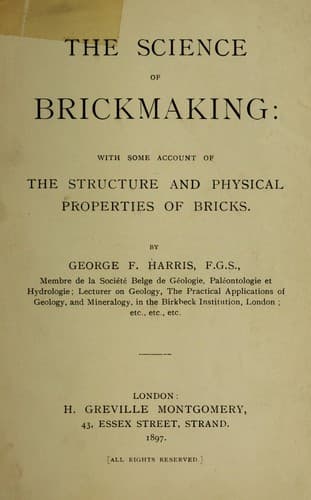
The Science of BrickmakingHarris, George Frederick
Science
The Science of Brickmaking
Harris, George Frederick
Brickmaking -- Handbooks, manuals, etc.
Two minerals commonly met with in earths used for brickmaking
are pyrite and marcasite, both of which are of the same chemical
composition, namely, iron disulphide. We may first consider them
separately, for they are of great importance to the brickmaker.
Iron pyrite occurs as regular cubic crystals, or irregular streaks,
or as nodules or lumps; in clay, the last-mentioned is its commonest
form. It is a good petrifying medium, so that it is frequently
associated with organic remains, as is exemplified in almost any yard
where stiff clay is being worked. The nodules, on being broken open,
ordinarily exhibit a radiating structure of brassy lustre and extremely
beautiful appearance, though often marred by brown iron stains due to
decomposition of the mineral. In the refuse of slates, now so largely
used in several parts of the world for brickmaking, pyrite is most
frequently found as fine cubic crystals of a durable nature.
Marcasite, on the other hand, crystallizes in a different manner (in
the rhombic system of mineralogists), but is chiefly found in fibrous
masses or dirty-brown nodules, the last-mentioned being common in
clays. When bright it is paler in tint than pyrite, though this is not
a constant character. It occurs abundantly in almost all sedimentary
rocks diffused as minute particles, but sometimes in irregular layers.
Sir Archibald Geikie states[5] that this form of the sulphide is
especially characteristic of stratified rocks, and more particularly
of those of Secondary and Tertiary age. That it is not abundant in
Primary rocks is not to be wondered at when we consider its liability
to rapid decomposition; indeed, for it to be preserved at all it must
be well shielded from atmospheric agents by Nature. Exposure even for
a short time to the air causes it to become brown, free sulphuric acid
is produced, which may attack surrounding minerals, sometimes at once
forming sulphates, at other times decomposing aluminous silicates and
dissolving them in considerable quantity. It plays even a larger part
than pyrite as a petrifying medium, at any rate in the younger rocks.
Both pyrite and marcasite are abundant in many other rocks than those
of special interest to the brickmaker; the former, in fact, is almost
universal in its occurrence.
Public-domain text, read in full here on John Shaqi.
Reviews
Reviews
No reviews yet
Be the first to share your thoughts on this work.
Join the Discussion
Join the discussion
Sign in to leave a comment or review.
Sign InorCreate an account