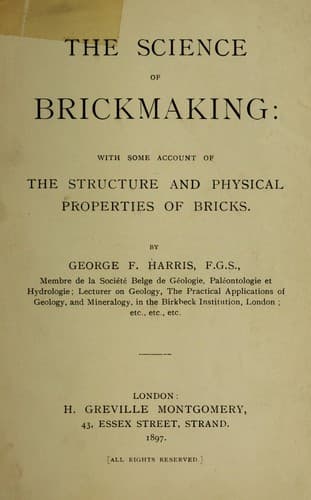
The Science of BrickmakingHarris, George Frederick
Science
The Science of Brickmaking
Harris, George Frederick
Brickmaking -- Handbooks, manuals, etc.
Iron may occur in clays simply as a stain, when it is usually not in
large quantity, or it may occur combined with some mineral or minerals
present--as for instance certain felspars and micas. The brown, yellow,
or blue appearance of the clay is due to it. In loam it may be found
also as a species of ochreous earth, and in thin bedded loams (as the
upper part of the Woolwich and Reading series of the London basin)
each layer frequently varies in the proportion of iron present. In the
more arenaceous parts of these loamy deposits, little grains of iron
sometimes make their appearance, as also in certain sands employed in
brickmaking; on careful examination, however, many of these grains are
found to be other mineral substances coated with iron. Certain horizons
in what are known as the Jurassic rocks contain great quantities of
ferruginous matter in little pellets.
Iron, in large proportion, acts as a flux to other constituents when
the brick-earth is subjected to great heat in the kiln, and on that
account must be carefully watched. But, to the average brickmaker,
the ferruginous constituent is far more interesting as a colouring
medium. At a later stage we shall have something to say concerning the
colouring of bricks, &c., but it may now be remarked that red bricks,
in practically all cases, owe their colour to the effects of firing
on iron. It is a great mistake to imagine, however, that a large
percentage of iron in a clay will necessarily produce a good red tint.
In the first place, a great deal depends on the way the clay has been
mixed or prepared; and in the second, the method of burning and the
temperature employed, taken in conjunction with the general composition
of the earth, are all important. This much may be said, however,
that without the iron (or some mineral colouring matter possessing
similar properties in the kiln) a red brick would not result. An even
colour is the effect of thorough and homogeneous incorporation of
the iron with the brick-earth; that may have been brought about by
natural processes, but it is most frequently obtained in the careful
preparation and mixing of the clays. A very essential point is that
the earths must be of such a character as to withstand the requisite
heat in the kiln without becoming vitreous, or twisting or warping.
It must not be forgotten that a certain proportion of the iron, under
great temperatures, may be carried away out of the kiln in union with
other things, in the form of vapour. To successfully treat a raw earth,
so that all these points may be taken into account, and to produce a
thoroughly uniform red brick, that shall not vary in tint from kiln
to kiln, is a matter requiring considerable skill and attention,
though fairly good bricks of that character have been produced by
sheer accident in burning natural earths fairly rich in thoroughly
disseminated iron oxides.
Public-domain text, read in full here on John Shaqi.
Reviews
Reviews
No reviews yet
Be the first to share your thoughts on this work.
Join the Discussion
Join the discussion
Sign in to leave a comment or review.
Sign InorCreate an account