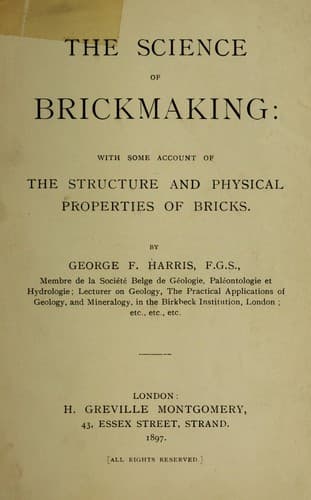
The Science of BrickmakingHarris, George Frederick
Science
The Science of Brickmaking
Harris, George Frederick
Brickmaking -- Handbooks, manuals, etc.
When present as hard crystalline lumps or pebbles, they have been
derived from the destruction of limestones, and are then the greatest
nuisance imaginable to the brickmaker and the most dangerous
constituent at the same time. With proper machinery these hard lumps
may be ground down to fine particles, but they are even then only to be
admitted into the earth on sufferance. The best plan, without doubt,
is to remove them altogether from the raw earth. They are commonly met
with in what the geologist calls “boulder clay”--a deposit owing its
origin to glaciers and icebergs. Very often the pebbles alluded to
are not crystalline, but of an earthy character, as is the case when
made of chalk. In the semi-dry process of manufacture, it is next to
impossible to incorporate the ground-up particles of carbonate lime
sufficiently well to result in the production of such a homogeneous
earth as is desirable for making a first-class brick.
In sandy clays or loams, and in a few stiff clays used for brickmaking,
certain remarkable concretions called “race” are found, the deleterious
properties whereof are so well known to the average brickmaker that
he carefully avoids the particular strata in which they occur. It is
fortunate that these concretions have a habit of being confined to
narrow limits along definite horizons in the brickyard section, so that
they may be readily discarded in working. But that is not always the
case, and little nodules of “race” are usually more or less frequent
also in the beds above and below the horizons referred to. They are
composed wholly of carbonate of lime, and their general effect in the
kiln, and afterwards, will presently be explained. Other forms of
concretions are known as “septaria,”--tabular or rounded masses of
argillaceous limestone found in practically all stiff clays. These are
often of enormous size, and are disposed in regular lines which the
field geologist takes to indicate bedding planes in the clay--otherwise
often very difficult to make out. In certain stiff clays little pellets
of the same substance are found. The larger septaria have commonly been
cracked in various directions, the fissures being subsequently filled
with calcite.
Coprolites are impure varieties of phosphate of lime, and the term
should, properly speaking, be restricted to a substance of organic
origin,--the fossilised excrement of animals. But the name is now
loosely employed to designate phosphatic concretions in general, such
as are commonly found in stiff clays, in certain “greensands,” and in
other sedimentary deposits. The dark brown phosphate of lime has formed
on and often completely envelopes many fossils; in certain cases it
has in fact been utilised as a petrifying medium, in which form it
ordinarily occurs in the thick black clays of Peterborough, Cambridge,
the gault of Kent, Surrey, etc.
Public-domain text, read in full here on John Shaqi.
Reviews
Reviews
No reviews yet
Be the first to share your thoughts on this work.
Join the Discussion
Join the discussion
Sign in to leave a comment or review.
Sign InorCreate an account