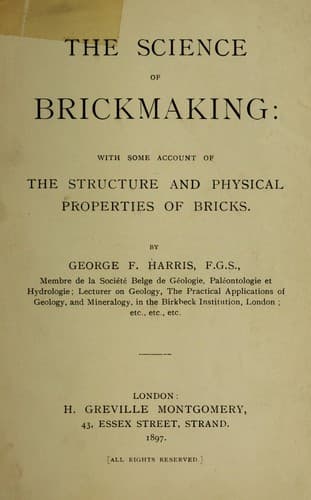
The Science of BrickmakingHarris, George Frederick
Science
The Science of Brickmaking
Harris, George Frederick
Brickmaking -- Handbooks, manuals, etc.
Summing up the effects of carbonates and other kinds of lime in the
kiln, it may be at once said that when present in any other form than
as extremely minute particles, they are distinctly to be avoided. The
small pellets and large pebbles especially are to be avoided, for the
following reasons. Carbonate of lime is made up of lime and carbonic
acid; if a lump of this be subjected to great heat and thus calcined,
the carbonic acid is driven off, escaping by means of flues, the
open chimney, or kiln. The product is lime pure and simple--ordinary
builders’ lime. Everyone knows that on the addition of water builders’
lime becomes “slacked,” and eventually, after a fashion, “sets.”
Precisely the same thing occurs in the brick-kiln. The raw brick is
often composed of pieces of chalk or other limestone, in limestone
districts and in areas where boulder clays are largely employed for
brickmaking. On being subjected to the heat of the kiln these pieces
are promptly reduced to the condition of lime. During the process
of conversion considerable expansion takes place, and subsequently
contraction, leading to the formation of cracks radiating from the
fragments of limestone, the homogeneity of the bricks being at once
destroyed. Apart from this, when placed in the open air the lime
becomes slacked, and the quality of the brick is seriously impaired.
Lime is a highly refractory substance, strongly basic in character,
and forms fusible compounds with silica and other acid bodies. It is,
therefore, useful as a flux in many earths used in brickmaking, being
added to them expressly for that purpose, to the general improvement
of the brick. The celebrated Dinas bricks, for instance, are composed
of a highly refractory earth containing about 97 per cent. silica, the
remainder being lime, oxide of iron, alumina, alkali and water. To
render this material fusible and so as to make refractory bricks, from
1 to 3 per cent. of lime is added.
Public-domain text, read in full here on John Shaqi.
Reviews
Reviews
No reviews yet
Be the first to share your thoughts on this work.
Join the Discussion
Join the discussion
Sign in to leave a comment or review.
Sign InorCreate an account