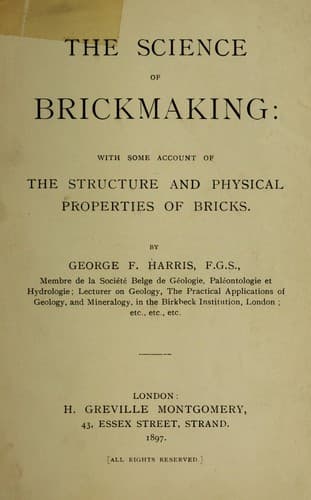
The Science of BrickmakingHarris, George Frederick
Science
The Science of Brickmaking
Harris, George Frederick
Brickmaking -- Handbooks, manuals, etc.
The “petrified water” of the brickmaker. It is a crystalline form of
gypsum--a hydrous sulphate of lime, occurring in large quantities in
the commonest clays used in brickmaking. Large and beautiful crystals,
some of them radiating from a central point, are found in the London
Clay, Kimeridge Clay, Oxford Clay, &c. By expelling the water from
selenite, or gypsum, plaster of Paris may be prepared. In the kiln,
therefore, it is important that this constituent be as finely ground as
possible, so as to localise the effects of the anhydrous sulphate on
being moistened subsequently. In hard burnt bricks, no doubt, a great
deal of it is effectively used as a flux to other constituents of the
clay; but in by far the larger quantity of bricks this sulphate is
reduced to fine powdery particles easily picked out as being softer and
lighter in tint than the remaining constituents. The weather-resisting
qualities of the brick are naturally, not improved when much baked
selenite is present; and the colour of the whole is apt to become
variegated--that is, in a fairly soft brick.
DOLOMITE.
Dolomite is, chemically, composed of the carbonates of lime and
magnesia in about equal proportions. It is found as rhombohedral
crystals, the faces of which are often curved; also in granular and
massive conditions. Its prevailing colour is light yellow both in
crystals and rock masses, but, as with most other minerals, impurities
occasionally make it assume other tints, principally red and green.
Carbonate of iron is frequently present, sometimes to such an extent as
to entirely alter the character of the substance. As separate crystals
dolomite has very little interest for us, though rarely it may take
the place of calcite or aragonite in the fossils of brick-earths and
clays. But in its massive condition, as magnesian limestone, it is of
increasing importance to the brickmaker. For many years it has been
utilised in the manufacture of basic bricks, though at the present
moment the market in these materials is attentively looking at the
possibilities of the next mineral to be described.
MAGNESITE.
Public-domain text, read in full here on John Shaqi.
Reviews
Reviews
No reviews yet
Be the first to share your thoughts on this work.
Join the Discussion
Join the discussion
Sign in to leave a comment or review.
Sign InorCreate an account