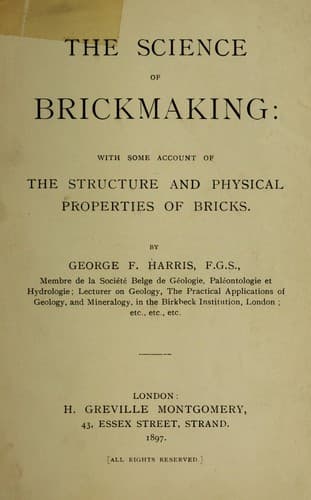
The Science of BrickmakingHarris, George Frederick
Science
The Science of Brickmaking
Harris, George Frederick
Brickmaking -- Handbooks, manuals, etc.
Magnesite is pure carbonate of magnesia--that is, magnesia = 47.6, and
carbonic acid 52.4 per cent. It usually occurs massive or fibrous,
but sometimes granular, and its fine rhombohedral crystals are well
known. Like dolomite, its prevailing tint is yellow or light brown,
but, when very pure, is as white as snow. It is usually associated
with serpentine rocks. In the kiln it is highly refractory, and
behaves very much in the same way as lime--forming fusible compounds
with silica and silicates. For the higher grades of basic bricks it
is at this moment largely exploited in the few localities where it
occurs in paying quantities. A few years since, investigation to
determine the best basic refractory material was actively prosecuted
in Germany, and magnesia, preheated at the highest white heat, was
awarded the palm. Magnesite, when calcined, yields magnesia, which,
however, still contains the impurities that might have been present in
the raw material. An average percentage composition of the magnesite
of commerce shows it to contain magnesia 45, carbonic acid 50, lime
1.5, protoxide of iron 1.6, the remainder being silica, alumina,
and protoxide of manganese. The presence of silica in magnesite is
an objection, because it is liable to have a fluxing effect at high
temperatures.
Magnesite has been found in paying quantities in California, Styria,
and recently in Greece. In Eubœa, in the last-mentioned country,
the mineral occurs in lodes which, near Krimasi, are worked on two
levels 30 to 40 feet from the top, and dipping at an angle of about
70 degrees. The general average of the lode gives 88 per cent. of
carbonate of magnesia, and the substance is peculiarly suitable for
the manufacture of basic bricks. A novelty with the raw material is
that the proprietors sell either by guaranteed degree, or degree of
analysis, the former being 95 per cent. of pure magnesia, whilst the
latter often gives as much as 97.8 per cent. In inferior grades the
principal increase is in the proportion of silica.
SALT.
Public-domain text, read in full here on John Shaqi.
Reviews
Reviews
No reviews yet
Be the first to share your thoughts on this work.
Join the Discussion
Join the discussion
Sign in to leave a comment or review.
Sign InorCreate an account