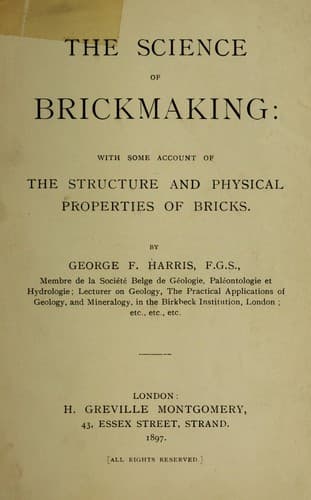
The Science of BrickmakingHarris, George Frederick
Science
The Science of Brickmaking
Harris, George Frederick
Brickmaking -- Handbooks, manuals, etc.
The results of a chemical analysis of a compound earth, as ordinarily
used by the brickmaker, widely differ from those obtained by a
mineralogical or petrological examination. The petrologist views
the earth as a mineral aggregate, the constituents of which may be
ascertained on appeal to a properly-constructed microscope--that is, in
the majority of instances. By noting the relative proportions of the
different minerals, he is enabled to state, with approximate accuracy,
what is the ultimate chemical composition of the whole. From this it
would appear that a rough chemical analysis could be drawn up by the
petrologist without having recourse to the ordinary methods of chemical
investigation. And in a limited sense that is true. But we should not
lose sight of the fact that there is, in too many cases, an amorphous
residuum in earths, the nature whereof the microscope is powerless to
reveal. It is upon this remnant that the chemist should direct his most
careful attention.
The mineralogist also can give a shrewd idea of the chemical
composition of a brick-earth by using a blowpipe and accessories. This,
in fact, may be regarded as a chemical means of investigation; but
it possesses this serious drawback, viz., the blowpipe only yields a
qualitative, and not a quantitative analysis. In other words, it can
tell us something concerning chemical compounds present in an earth,
but rarely informs us as to the relative proportions of them. Even
this, however, is of great service in many instances, though it does
not possess the value of a quantitative analysis. For example, we
have stated previously that certain ingredients are very undesirable
in a brick-earth, even in minute quantities; and that fact becomes of
increased value if we extend the field to earths used in terra-cotta,
and china and porcelain manufacture. Now, the blowpipe is a handy
instrument; it may be carried about by the prospector with its usual
accessories, and occupies but little space. Suppose he discovers a bed
of white earth which he believes to be good china-clay; he can prove
that fact, or at least obtain a great deal of information to that
end, by the mere use of that useful little instrument. Knowing, for
example, that fluorine is an undesirable constituent in such a clay for
many high-class purposes, he might test first of all for that; iron,
perhaps, may come next, and so in a few minutes he is enabled to arrive
at some valuable particulars that would take much longer to obtain by
chemistry in the wet way.
Public-domain text, read in full here on John Shaqi.
Reviews
Reviews
No reviews yet
Be the first to share your thoughts on this work.
Join the Discussion
Join the discussion
Sign in to leave a comment or review.
Sign InorCreate an account