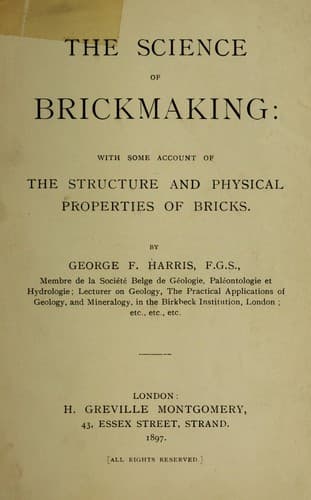
The Science of BrickmakingHarris, George Frederick
Science
The Science of Brickmaking
Harris, George Frederick
Brickmaking -- Handbooks, manuals, etc.
Chloride of sodium, or common salt, is present in many natural clays,
especially (in England) in that formation known to geologists as the
Trias, developed largely in Cheshire. The influence of a salt-bearing
bed is, naturally, not confined to the immediate vicinity of the
formation; salt being so readily soluble in water, it comes forth from
the rocks in springs, which, flowing over loams and other similar
absorbent earths, impart a saline character to them. In this manner
otherwise useful earths for brickmaking are rendered absolutely unfit
for the purpose. Salt is one of the most powerful fluxes known; when
mixed even in very small quantities with clay it becomes impossible
to make a good brick of the substance. But we must recur to this
matter at a later period in another connection. The fluxing property
is sometimes taken advantage of by mixing salt with sand in moulding,
or in employing a sand already saline, as when dredged from the sea,
or obtained between tide-marks. A species of glaze is produced on the
brick by the action of such moulding sand.
We may ignore the presence of a number of minerals such as rutile,
augite, and hornblende in brick-earths, as they only exist therein in
such small proportion, and have no appreciable effect in the kiln.
CHAPTER VII.
THE CHEMISTRY OF BRICK-EARTHS.
Introduction: THE BLOWPIPE.
It is not our intention to write an elementary treatise on chemistry;
but we know it is the custom for brickmakers to have chemical analyses
of their raw earths made, and we are aware also that the precise
meaning to be attached to these analyses is very little understood. Our
principal aim in introducing this subject, then, is to interpret, in an
elementary manner, certain typical analyses of earths and substances
used in brickmaking; but before doing so we shall explain some easy
methods of examining earths by means of the blowpipe, which will not
merely give some insight into their chemical constitution, but will
afford the intelligent brickmaker a means of investigation which he can
himself put into practice.
Public-domain text, read in full here on John Shaqi.
Reviews
Reviews
No reviews yet
Be the first to share your thoughts on this work.
Join the Discussion
Join the discussion
Sign in to leave a comment or review.
Sign InorCreate an account