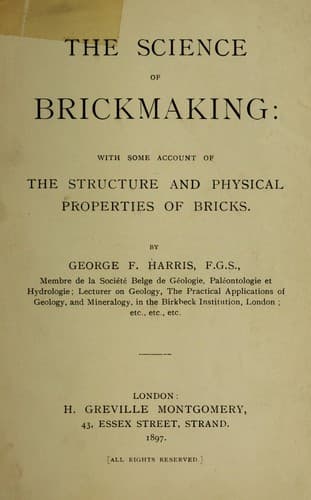
The Science of BrickmakingHarris, George Frederick
Science
The Science of Brickmaking
Harris, George Frederick
Brickmaking -- Handbooks, manuals, etc.
_Limonite Iron._--Fusibility about 5; yellow and reddish beads;
water given off in closed tube; in reducing flame magnetic residue on
charcoal; soluble in hydrochloric acid after a short time.
_Iron Pyrites._--Fusibility about 2; yellow and red beads; in closed
tube yellow precipitate due to sulphur; magnetic after reduction on
charcoal; insoluble in hydrochloric acid.
_Rock Salt._--Intense yellow sodium flame; fusibility about 1;
microcosmic salt with copper oxide shows strong chlorine reaction--a
fine blue flame surrounding the bead when re-introduced into the flame.
It is soluble in water.
_Selenite_ (_Gypsum_).--Fusibility about 2.5; brilliant flame; in
closed tube it becomes white and opaque and much water is given off;
with soda, on charcoal, sulphur reactions are obtained; soluble in
hydrochloric acid.
_Calcite_ (_Carbonate of Lime_).--Flame glows very strongly; infusible;
effervesces freely in cold hydrochloric acid.
_Dolomite._--Flame, with hydrochloric acid, like calcite; infusible;
effervesces in hot hydrochloric acid.
_Magnesite._--Infusible; with cobalt nitrate a fair magnesia reaction
on charcoal, _i.e._, turns into a dull pink; effervesces in hot
hydrochloric acid.
_Manganese._--With borax in oxidising flame a red-violet bead is
obtained, but with the reducing flame it is colourless.
The above are commonly met with in brick-earths; for other minerals
and substances also found, the reader may be referred to special works
dealing with blowpipe analysis.
CHAPTER VIII.
THE CHEMISTRY OF BRICK-EARTHS (_Continued_).
In this chapter we shall fulfil our promise (_ante_ p. 58) to explain
in an elementary manner the precise meaning of ordinary commercial
chemical analyses of some typical earths used in brickmaking, etc. We
may commence by explaining a few terms used by the chemist.
An _atom_ is the smallest imaginable portion of matter, and all matter
is said to consist of atoms. A _molecule_ is the smallest conceivable
combination of atoms, and every compound substance is ultimately built
up of molecules. An _element_ is a substance that has hitherto defied
the efforts of the chemist to subdivide or split up. Over seventy of
these elementary substances are at present known, and their number is
being constantly added to. Again, by improvement in analytical methods,
a so-called element may be subdivided, and thus removed from the list.
The elements are classified into _metals_ and _non-metals_; and it is
convenient to give each of them a symbol to save trouble in writing,
and to render clearer to the reader the chemical nature of a compound
body. Thus, the symbol for the element aluminium is Al; for silicon Si;
for carbon C; for calcium Ca; for oxygen O; for iron Fe; for hydrogen
H; for chlorine Cl; and so on.
Public-domain text, read in full here on John Shaqi.
Reviews
Reviews
No reviews yet
Be the first to share your thoughts on this work.
Join the Discussion
Join the discussion
Sign in to leave a comment or review.
Sign InorCreate an account