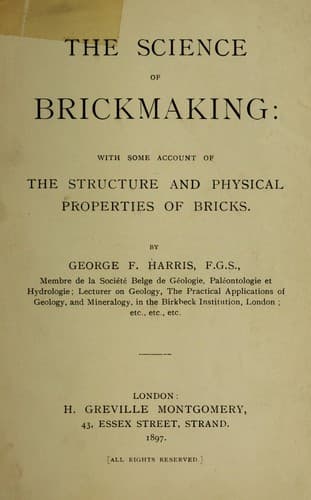
The Science of BrickmakingHarris, George Frederick
Science
The Science of Brickmaking
Harris, George Frederick
Brickmaking -- Handbooks, manuals, etc.
We are taught by chemistry that elements are capable of combining only
in definite proportions, and that each substance possesses a definite
proportion peculiar to itself. That proportion is called the _atomic
weight_ of the element; or, it is the relative weight of the atom of
each substance compared with that of the lightest substance known,
hydrogen.
Thus, the atomic weight of hydrogen being taken as 1, it is found that
an atom of chlorine is 35.5 times as heavy as that, so that the atomic
weight of chlorine is said to be 35.5. Now, in spite of the enormous
difference between the weight of the two elements just mentioned, they
combine in the same proportions by _volume_; and the union is known as
hydrochloric acid, or HCl.
But in certain cases elements do not combine in equal proportions;
for instance, an atom of oxygen will not combine with less than two
of hydrogen. Further, with this we find that the three volumes are
condensed into the space of two volumes--a very common phenomenon in
the chemical combination of gases. The union of hydrogen and oxygen
alluded to forms water, the chemical symbol of which is, consequently,
H2O.
_Chemical affinity_, or _chemical attraction_, is the force which is
exerted between molecules not of the same kind. Thus, in water, which,
as we have seen, is composed of hydrogen and oxygen, it is affinity
which unites these elements, but it is cohesion which binds together
two molecules of water. In compound bodies, cohesion and affinity
operate simultaneously; whilst in simple bodies, or elements, cohesion
alone has to be considered. To affinity are due all the phenomena of
combustion and of chemical combination and decomposition.
Certain gases, such as chlorine and nitrogen, and such substances
as sulphur, carbon, and silicon, with many others, form _acids_ in
conjunction with hydrogen, or hydrogen and oxygen. These combine
with greater or less facility with other elements which do not form
acids, and are termed _bases_. A combination of an acid and a base is
known as a _salt_. Salts the names of which end in _-ide_, such as
chloride, sulphide, etc., are combinations of a metal with a non-metal.
_Monoxide_ means an oxide containing one atom of oxygen; _dioxide_ one
containing two atoms; _protoxide_ means the first oxide, because it
is the first or lowest of the oxides of the given metal in amount of
oxygen present; the highest oxide is often known as _peroxide_. The
terminations _-ous_ and _-ic_ are frequently used for the lower and
higher oxides respectively. Examples:--
FeO, iron protoxide, or ferrous oxide.
Fe2O3, iron sesquioxide, or ferric oxide.
FeS2, iron disulphide.
Sb2S3, antimony trisulphide.
The following symbols may be indicated as referring to compounds
especially met with in brick-earths:--
Public-domain text, read in full here on John Shaqi.
Reviews
Reviews
No reviews yet
Be the first to share your thoughts on this work.
Join the Discussion
Join the discussion
Sign in to leave a comment or review.
Sign InorCreate an account