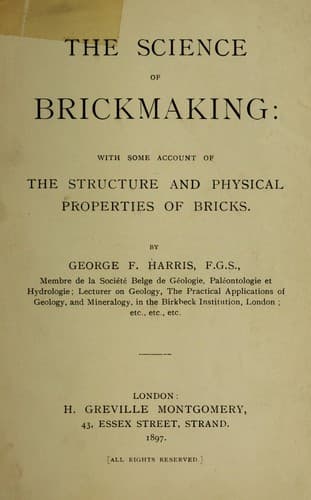
The Science of BrickmakingHarris, George Frederick
Science
The Science of Brickmaking
Harris, George Frederick
Brickmaking -- Handbooks, manuals, etc.
The proportion of silica in this is higher than in many clays used for
brick- or terra-cotta making, but the alkalis, potash and soda, are
in strong force, so that any refractoriness on the part of the silica
is soon subdued in the kiln. The iron, also, is in abundance. The
principal colouring ingredient is the sesquioxide, and we can quite
understand the manufacturer when he informs us that, in spite of the
rich tint of the goods produced, nothing is artificially mixed with
this clay to produce such a result. We may call attention to the method
of expressing the chemical analysis in this case, which might be copied
to advantage. In the first place, the combined and the uncombined
iron are separately shown, or rather the degree of combination is
indicated; and secondly, the proportion of water chemically combined
is differentiated from that which has simply soaked into the clay,
though expelled, following a well-known practice of chemists, prior to
commencing the analysis proper. It is of very little use giving the
amount of water, unless the proportions are divided in this manner. In
the result given above we learn that there is very little chance of the
clay shrinking, as it only contains moisture to the extent of 1.54 per
cent.; but if that had been added to the water combined, we should have
had a result of 5.08 per cent., which is not nearly so clear in its
meaning. We may add that the Ruabon earth referred to is utilised also
in the manufacture of tesselated and encaustic tiles.
In regard to the composition of earths employed in the manufacture of
the commoner kinds of bricks, we may give the following examples:--
_Chemical Composition of Common Brick-earths._
-------------------+-------+-------+------+---------+----------+------
| |Alumina| | | | Water
|Silica.| and | Lime.|Magnesia.|Manganese.| and
| | Iron. | | | | Loss.
+-------+-------+------+---------+----------+------
Reddish-brown | | | | | |
brick clay | 52.6 | 30.8 | 3.4 | 2.8 | 1.4 | 9.0
Red-brick clay | 50.4 | 24.0 | 2.7 | 1.3 | --- | 21.6
Common brick-earth | 33.0 | 11.2 | 39.8 | 6.0 | --- | 10.0
Sandy-clay (loam) | 60.2 | 24.0 | 2.4 | 1.6 | --- | 11.8
-------------------+-------+-------+------+---------+----------+------
Public-domain text, read in full here on John Shaqi.
Reviews
Reviews
No reviews yet
Be the first to share your thoughts on this work.
Join the Discussion
Join the discussion
Sign in to leave a comment or review.
Sign InorCreate an account