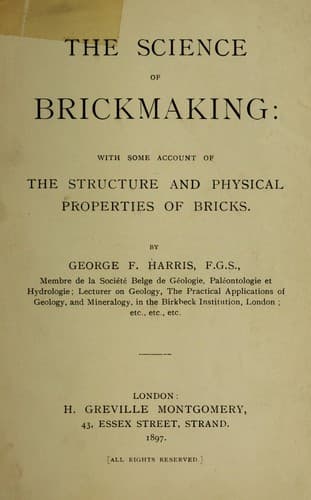
The Science of BrickmakingHarris, George Frederick
Science
The Science of Brickmaking
Harris, George Frederick
Brickmaking -- Handbooks, manuals, etc.
Reviewing these results, it will be noted that the brown colouring
imparted to the brick in the first-mentioned example is due, to a
large extent, to the presence of manganese, a rather uncommon feature
in brick-earths, except where these have resulted from the denudation
of iron-producing rocks rich in manganese. It will be noticed also
that the proportion of water is not high for a common earth, and it
must be a fairly easy material to deal with. There seem to be some
possibilities in it that might, in competent hands, lead to higher
things. The amount of lime and magnesia is, however, a rather serious
one for a first-class clay.
In regard to the “red-brick” clay, an essential feature is the
comparative absence of lime, and it would, no doubt, make “rubbers”
of an ordinary kind. Unfortunately, in the results given, the iron is
not separated from the alumina, but clearly the latter is very small
in amount, and the results refer to a sandy material. The proportion
of water is disastrous for the employment of this earth by unskilful
hands. In drying, the greatest care would have to be exercised to
prevent undue shrinking, and, in any case, the earth would have to be
very thoroughly incorporated to make a really serviceable brick. It
is with earths of this character that the majority of brickmakers _in
embryo_ come to grief; they know not how to handle them successfully,
and twisting, warping, cracking, and “bursting” follow as a natural
consequence. It is a common and treacherous material, that could only
be made to succeed by perseverance and wide experience.
The “common brick-earth,” as will be seen, contains an abnormal
quantity of lime, and doubtless refers to a marl, though not much
alumina is shown. Malm bricks could be made from it, and the product
would have to be burned at a low temperature. For bricks useful to the
“jerry-builder” this earth could be strongly recommended. It was, no
doubt, mainly derived from limestone rocks; and, judging from the high
proportion of magnesia, probably from within a watershed composed to
some extent of magnesian limestone.
The “sandy-clay” or loam is of a very common type, and produces
light-red bricks. There is much in common between this and the
“red-brick clay” previously referred to.
Public-domain text, read in full here on John Shaqi.
Reviews
Reviews
No reviews yet
Be the first to share your thoughts on this work.
Join the Discussion
Join the discussion
Sign in to leave a comment or review.
Sign InorCreate an account