The Scientific Evidences of Organic Evolution — John Shaqi
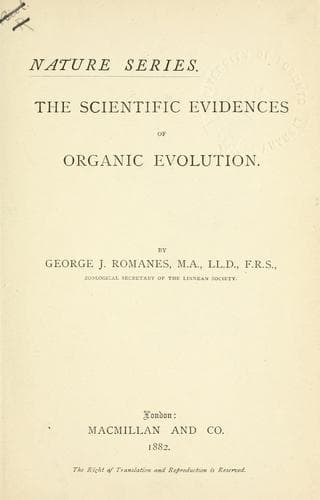
The Scientific Evidences of Organic EvolutionRomanes, George John
Science
The Scientific Evidences of Organic Evolution
Romanes, George John
Evolution
whereas dissection shows that it is beyond all comparison more unlike a
fish than it is like a horse or a man. This is, of course, an extreme
case; but it was cases such as this that first led naturalists to see
that there are resemblances between organisms much more deep and
important than appear upon the surface; and consequently, that if a
natural classification was possible at all, it must be made with
reference to these deeper resemblances. Of course, it took time to
perceive this distinction between fundamental and superficial
resemblances. I remember once reading a very comical disquisition in one
of Buffon's works on the question as to whether or not a crocodile was
to be classified as an insect; and the instructive feature in the
disquisition was this, that although a crocodile differs from an insect
as regards every conceivable particular of its internal anatomy, no
allusion at all is made to this fact, while the whole discussion is made
to turn on the hardness of the external casing of a crocodile resembling
the hardness of the external casing of a beetle; and when at last Buffon
decides that, on the whole, a crocodile had better not be classified as
an insect, the only reason given is, that as a crocodile is so very
large an animal, it would make "altogether too terrible an insect."
But now, when at last it came to be recognised that internal anatomy
rather than external appearance was to be taken as a guide to
classification, the question was, What features in the internal anatomy
are to take precedence over the other features? And this question it was
not hard to answer. A porpoise, for instance, has a large number of
teeth, and in this feature resembles most fish, while it differs from
all mammals. But it also gives suck to its young, and in this feature it
differs from all fish, while it resembles all mammals. Now, looking at
those two features alone, should we say that a porpoise ought to be
classed as a fish or as a mammal? Assuredly as a mammal, and for this
reason: The number of teeth is a very variable feature both in fish and
in mammals, whereas the giving of suck is an invariable feature among
mammals, and occurs nowhere else in the animal kingdom. This, of course,
is purposely chosen as a very simple illustration; but it exemplifies
the general fact that the guiding principle of scientific
classification is the comparing of organism with organism, with the view
of seeing which of the constituent organs are of the most invariable
occurrence, and therefore of the most typical signification.
Public-domain text, read in full here on John Shaqi.
Reviews
Reviews
No reviews yet
Be the first to share your thoughts on this work.
Join the Discussion
Join the discussion
Sign in to leave a comment or review.
Sign InorCreate an account