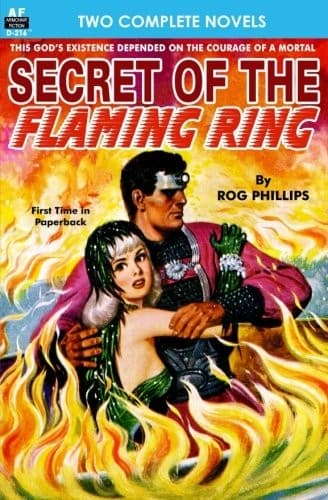
Mars (Planet) -- Fiction; Mystery fiction; Science fiction
Going Los Angeles one ridge better, Marsport was completely
circumscribed by high crimson hills, and this natural bowl formation,
plus oxygen's heavier-than-air-density, allowed the city to be filled
with breathable atmosphere, much as tobacco smoke can lie surging
gently within an ashtray if the air in a room is still. This made
planetary wind-storms a hazard.
Outside the hills, of course, the air was thin, cold and barely
able to support life, being comparable to the biting cold air atop
Mount Everest. Human lungs could not breathe it for long without
freezing. Naturally, there was a high casualty rate amongst the
prospectors, despite their pressurized metal huts and oxygen masks.
But uranium, as it had been since the advent of the atomic age, was
enormously well-paying to the one miner in twenty to find any in
Mars' body breaking hinterlands with its roasting dry heat of day and
blood-freezing cold by night.
And then there was parabolite.
This mineral, found in abundance beneath the Martian sands, was,
theoretically, worth ten times its weight in gold to the people who
might mine it. I say theoretically, because no one had as yet found
a way of getting any ore. Paradoxically, the feature which made
parabolite so vitally desired was the same feature which prevented
anyone from mining it: it was totally indestructible.
The name had been given it by the scientists who studied the three
solitary fragments of it found small enough for shipping back to Earth.
There was just no way of chipping a piece loose for analysis. The name
was due to the oddly shaped molecules which made up this mineral. All
of them seemed to be joined atomically into perfect parabolas, no
matter which way you came at them. Which meant, in effect, that when
anything was brought to bear against the substance, pressure which
struck one end of the parabolically curved molecules was retransmitted
by the other end, back to the thing putting pressure on it. Result: it
"hit back" with a violence equal to that applied to it, and sustained
no damage whatsoever to itself. Chemicals were tried when pickaxes had
failed, but the substance was inert. It gave no sign of reacting either
to hydrofluoric acid, which could eat its way through glass, or to aqua
regia, which could eat through anything else.
They even tried using the collapsers on it. These deadly weapons, which
worked by the simple process of killing the attraction between the
protons and electrons, could, in the briefest time, reduce anything
to less than dust. The electrons spun away in a blinding blue-white
flash, and the stripped-down protons, being less than atomic in size,
fell silently down into the heart of the planet, leaving a virtual
nothingness where the object had been.
Public-domain text, read in full here on John Shaqi.
Reviews
Reviews
No reviews yet
Be the first to share your thoughts on this work.
Join the Discussion
Join the discussion
Sign in to leave a comment or review.
Sign InorCreate an account