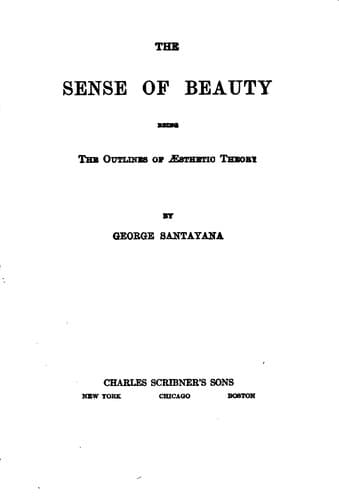
The Sense of Beauty: Being the Outlines of Aesthetic TheorySantayana, George
Philosophy
The Sense of Beauty: Being the Outlines of Aesthetic Theory
Santayana, George
Aesthetics
Sec. 9. The supposed disinterestedness of our love of beauty passes
into another characteristic of it often regarded as essential, -- its
universality. The pleasures of the senses have, it is said, no
dogmatism in them; that anything gives me pleasure involves no
assertion about its capacity to give pleasure to another. But when I
judge a thing to be beautiful, my judgment means that the thing is
beautiful in itself, or (what is the same thing more critically
expressed) that it should seem so to everybody. The claim to
universality is, according to this doctrine, the essence of the
aesthetic; what makes the perception of beauty a judgment rather
than a sensation. All aesthetic precepts would be impossible, and
all criticism arbitrary and subjective, unless we admit a paradoxical
universality in our judgment, the philosophical implications of
which we may then go on to develope. But we are fortunately not
required to enter the labyrinth into which this method leads; there
is a much simpler and clearer way of studying such questions,
which is to challenge and analyze the assertion before us and seek
its basis in human nature. Before this is done, we should run the
risk of expanding a natural misconception or inaccuracy of thought
into an inveterate and pernicious prejudice by making it the centre
of an elaborate construction.
That the claim of universality is such a natural inaccuracy will not
be hard to show. There is notoriously no great agreement upon
aesthetic matters; and such agreement as there is, is based upon
similarity of origin, nature, and circumstance among men, a
similarity which, where it exists, tends to bring about identity in all
judgments and feelings. It is unmeaning to say that what is
beautiful to one man _ought_ to be beautiful to another. If their
senses are the same, their associations and dispositions similar,
then the same thing will certainly be beautiful to both. If their
natures are different, the form which to one will be entrancing will
be to another even invisible, because his classifications and
discriminations in perception will be different, and he may see a
hideous detached fragment or a shapeless aggregate of things, in
what to another is a perfect whole -- so entirely are the unities of
function and use. It is absurd to say that what is invisible to a given
being _ought_ to seem beautiful to him. Evidently this obligation
of recognizing the same qualities is conditioned by the possession
of the same faculties. But no two men have exactly the same
faculties, nor can things have for any two exactly the same values.
Public-domain text, read in full here on John Shaqi.
Reviews
Reviews
No reviews yet
Be the first to share your thoughts on this work.
Join the Discussion
Join the discussion
Sign in to leave a comment or review.
Sign InorCreate an account