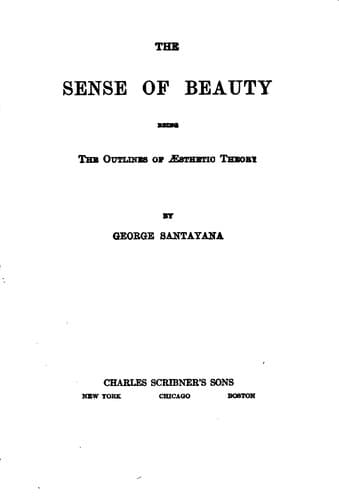
The Sense of Beauty: Being the Outlines of Aesthetic TheorySantayana, George
Philosophy
The Sense of Beauty: Being the Outlines of Aesthetic Theory
Santayana, George
Aesthetics
The invectives of one school against another, perverse as they are
philosophically, are artistically often signs of health, because they
indicate a vital appreciation of certain kinds of beauty, a love of
them that has grown into a jealous passion. The architects that have
pieced out the imperfections of ancient buildings with their own
thoughts, like Charles V. when he raised his massive palace beside
the Alhambra, may be condemned from a certain point of view.
They marred much by their interference; but they showed a
splendid confidence in their own intuitions, a proud assertion of
their own taste, which is the greatest evidence of aesthetic sincerity.
On the contrary, our own gropings, eclecticism, and archaeology
are the symptoms of impotence. If we were less learned and less
just, we might be more efficient. If our appreciation were less
general, it might be more real, and if we trained our imagination
into exclusiveness, it might attain to character.
_The differentia of aesthetic pleasure: its objectification._
Sec. 10. There is, however, something more in the claim to
universality in aesthetic judgments than the desire to generalize our
own opinions. There is the expression of a curious but well-known
psychological phenomenon, viz., the transformation of an element
of sensation into the quality of a thing. If we say that other men
should see the beauties we see, it is because _we_ think those
beauties _are in the object,_ like its colour, proportion, or size. Our
judgment appears to us merely the perception and discovery of an
external existence, of the real excellence that is without. But this
notion is radically absurd and contradictory. Beauty, as we have
seen, is a value; it cannot be conceived as an independent existence
which affects our senses and which we consequently perceive. It
exists in perception, and cannot exist otherwise. A beautynot
perceived is a pleasure not felt, and a contradiction. But modern
philosophy has taught us to say the same thing of every element of
the perceived world; all are sensations; and their grouping into
objects imagined to be permanent and external is the work of
certain habits of our intelligence. We should be incapable of
surveying or retaining the diffused experiences of life, unless we
organized and classified them, and out of the chaos of impressions
framed the world of conventional and recognizable objects.
Public-domain text, read in full here on John Shaqi.
Reviews
Reviews
No reviews yet
Be the first to share your thoughts on this work.
Join the Discussion
Join the discussion
Sign in to leave a comment or review.
Sign InorCreate an account