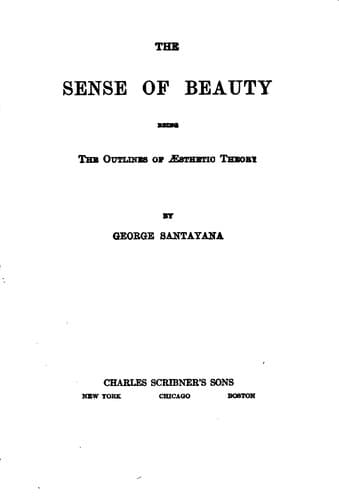
The Sense of Beauty: Being the Outlines of Aesthetic TheorySantayana, George
Philosophy
The Sense of Beauty: Being the Outlines of Aesthetic Theory
Santayana, George
Aesthetics
How this is done is explained by the current theories of perception.
External objects usually affect various senses at once, the
impressions of which are thereby associated. Repeated experiences
of one object are also associated on account of their similarity;
hence a double tendency to merge and unify into a single percept,
to which a name is attached, the group of those memories and
reactions which in fact had one external thing for their cause. But
this percept, once formed, is clearly different from those particular
experiences out of which it grew. It is permanent, they are variable.
They are but partial views and glimpses of it. The constituted
notion therefore comes to be the reality, and the materials of it
merely the appearance. The distinction between substance and
quality, reality and appearance, matter and mind, has no other
origin.
The objects thus conceived and distinguished from our ideas of
them, are at first compacted of all the impressions, feelings, and
memories, which offer themselves for association and fall within
the vortex of the amalgamating imagination. Every sensation we
get from a thing is originally treated as one of its qualities.
Experiment, however, and the practical need of a simpler
conception of the structure of objects lead us gradually to reduce
the qualities of the object to a minimum, and to regard most
perceptions as an effect of those few qualities upon us. These few
primary qualities, like extension which we persist in treating as
independently real and as the quality of a substance, are those
which suffice to explain the order of our experiences. All the rest,
like colour, are relegated to the subjective sphere, as merely effects
upon our minds, and apparent or secondary qualities of the object.
But this distinction has only a practical justification. Convenience
and economy of thought alone determine what combination of our
sensations we shall continue to objectify and treat as the cause of
the rest. The right and tendency to be objective is equal in all, since
they are all prior to the artifice of thought by which we separate the
concept from its materials, the thing from our experiences.
The qualities which we now conceive to belong to real objects are
for the moat part images of sight and touch. One of the first classes
of effects to be treated as secondary were naturally pleasures and
pains, since it could commonly conduce very little to intelligent
and successful action to conceive our pleasures and pains as
resident in objects. But emotions are essentially capable of
objectification, as well as impressions of sense; and one may well
believe that a primitive and inexperienced consciousness would
rather people the world with ghosts of its own terrors and passions
than with projections of those luminous and mathematical concepts
which as yet it could hardly have formed.
Public-domain text, read in full here on John Shaqi.
Reviews
Reviews
No reviews yet
Be the first to share your thoughts on this work.
Join the Discussion
Join the discussion
Sign in to leave a comment or review.
Sign InorCreate an account