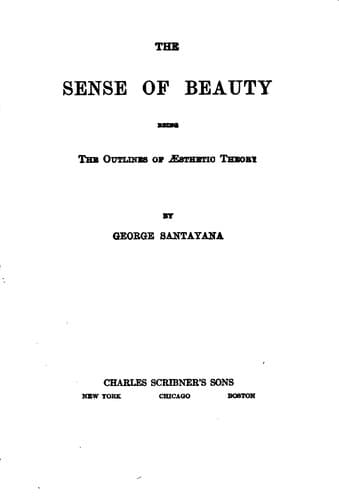
The Sense of Beauty: Being the Outlines of Aesthetic Theory — John Shaqi
The Sense of Beauty: Being the Outlines of Aesthetic TheorySantayana, George
Philosophy
The Sense of Beauty: Being the Outlines of Aesthetic Theory
Santayana, George
Aesthetics
What more could be needed to suffuse the world with the deepest
meaning and beauty? The attention is fixed upon a well-defined
object, and all the effects it produces in the mind are easily
regarded as powers or qualities of that object. But these effects are
here powerful and profound. The soul is stirred to its depths. Its
hidden treasures are brought to the surface of consciousness. The
imagination and the heart awake for the first time. All these new
values crystallize about the objects then offered to the mind. If the
fancy is occupied by the image of a single person, whose qualities
have had the power of precipitating this revolution, all the values
gather about that one image. The object becomes perfect, and we
are said to be in love.[2] If the stimulus does not appear as a
definite image, the values evoked are dispersed over the world, and
we are said to have become lovers of nature, and to have
discovered the beauty and meaning of things.
To a certain extent this kind of interest will centre in the proper
object of sexual passion, and in the special characteristics of the
opposite sex; and we find accordingly that woman is the most
lovely object to man, and man, if female modesty would confess it,
the most interesting to woman. But the effects of so fundamental
and primitive a reaction are much more general. Sex is not the only
object of sexual passion. When love lacks its specific object, when
it does not yet understand itself, or has been sacrificed to some
other interest, we see the stifled fire bursting out in various
directions. One is religious devotion, another is zealous
philanthropy, a third is the fondling of pet animals, but not the least
fortunate is the love of nature, and of art; for nature also is often a
second mistress that consoles us for the loss of a first. Passion then
overflows and visibly floods those neighbouring regions which it
had always secretly watered. For the same nervous organization
which sex involves, with its necessarily wide branchings and
associations in the brain, must be partially stimulated by other
objects than its specific or ultimate one especially in man, who,
unlike some of the lower animals, has not his instincts clearly
distinct and intermittent, but always partially active, and never
active in isolation. We may say, then, that for man all nature is a
secondary object of sexual passion, and that to this fact the beauty
of nature is largely due.
_Social instincts and their aesthetic influence._
Public-domain text, read in full here on John Shaqi.
Reviews
Reviews
No reviews yet
Be the first to share your thoughts on this work.
Join the Discussion
Join the discussion
Sign in to leave a comment or review.
Sign InorCreate an account