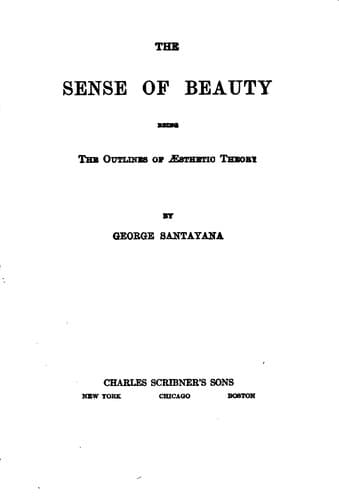
The Sense of Beauty: Being the Outlines of Aesthetic Theory — John Shaqi
The Sense of Beauty: Being the Outlines of Aesthetic TheorySantayana, George
Philosophy
The Sense of Beauty: Being the Outlines of Aesthetic Theory
Santayana, George
Aesthetics
Sec. 14. The function of reproduction carries with it not only direct
modifications of the body and mind, but a whole set of social
institutions, for the existence of which social instincts and habits
are necessary in man. These social feelings, the parental, the
patriotic, or the merely gregarious, are not of much direct value for
aesthetics, although, as is seen in the case of fashions, they are
important in determining the duration and prevalence of a taste
once formed. Indirectly they are of vast importance and play a
great role in arts like poetry, where the effect depends on what is
signified more than on what is offered to sense. Any appeal to a
human interest rebounds in favour of a work of art in which it is
successfully made. That interest, unaesthetic in itself, helps to fix
the attention and to furnish subject-matter and momentum to arts
and modes of appreciation which are aesthetic. Thus comprehension
of the passion of love is necessary to the appreciation of
numberless songs, plays, and novels, and not a few works of
musical and plastic art.
The treatment of these matters must be postponed until we are
prepared to deal with expression -- the most complex element of
effect. It will suffice here to point out why social and gregarious
impulses, in the satisfaction of which happiness mainly resides, are
those in which beauty finds least support. This may help us to
understand better the relations between aesthetics and _hedonics,_
and the nature of that objectification in which we have placed the
difference between beauty and pleasure.
So long as happiness is conceived as a poet might conceive it,
namely, in its immediately sensuous and emotional factors, so long
as we live in the moment and make our happiness consist in the
simplest things, -- in breathing, seeing, hearing, loving, and
sleeping, -- our happiness has the same substance, the same
elements, as our aesthetic delight, for it is aesthetic delight that
makes our happiness. Yet poets and artists, with their immediate
and aesthetic joys, are not thought to be happy men; they
themselves are apt to be loud in their lamentations, and to regard
themselves as eminently and tragically unhappy. This arises from
the intensity and inconstancy of their emotions, from their
improvidence, and from the eccentricity of their social habits.
While among them the sensuous and vital functions have the upper
hand, the gregarious and social instincts are subordinated and often
deranged; and their unhappiness consists in the sense of their
unfitness to live in the world into which they are born.
Public-domain text, read in full here on John Shaqi.
Reviews
Reviews
No reviews yet
Be the first to share your thoughts on this work.
Join the Discussion
Join the discussion
Sign in to leave a comment or review.
Sign InorCreate an account